Monthly Archives: June 2015

The Tale of a Tail

Too Much Tail

The tail is too big for the longer frame.

A you may recall, when I first loaded both of the horsemen panels on the longarm frame, the tail of the right panel hung off the edge.  At the time, I chose to ignore this and deal with it another day.  That day came.

The beginning of the solution involved removing both panels and reloading them one at a time.  This move actually solved two problems.  Thread painting the first horse caused that panel to draw up, in turn, making the second panel too loose on the frame.  The initial reason for loading both panels at the same time was so that the backgrounds could be stitched together, creating some continuity across both panels.  With that done, it is now obvious that that the panels will be completed one at a time.

With the second panel off the frame, I add extensions to the backing and batting.  When it is reloaded, I use clamps to hold that extension tight and in place while the stitching is completed. (sorry, forgot total a photo)
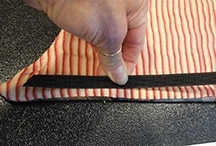
Boning to stiffen the tail

Boning to stiffen the tail

The next problem to be addressed is how to keep the tail from curling back or flopping forward when it is on display.  That solution comes from the notions department of my local fabric store:  polyester boning, typically used to give shape to a dress bodice.

This piece was finished with an artists facing, rather than a binding.  A strip of the boning was stitched into the bottom edge of the tail extension, then covered with the facing.  This seems sufficient to keep it in place.

Horse tail finished.

Horse tail finished.

Cover up with facing

Cover up with facing

Share

“No” to the Nose

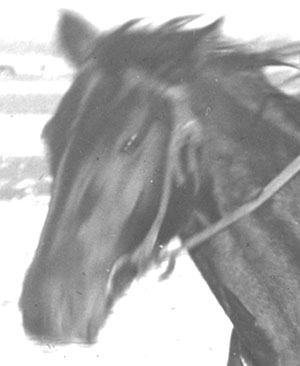
original nose

Original photo

When I thread paint, I rely on the thread to do the bulk of the work.  My technique allows me to blend colors and create subtle shading and contours, as if I were working with paint. In my process I find that there is an OTZ (Optimum Thread Zone).  Stitching below the zone creates what I consider dense quilting, and stitching above the zone overloads the fabric and causes it to expand and buckle.

With this in mind, I consider the facelift that is needed by my horse. As mentioned last week, the shape of the nose needs some adjusting.  However, having applied heavy stitching to the face already, there is a limited amount of thread that can be added without exceeding the OTZ. This means I need to get it right, right away.

In the original photo, the horse is moving his head as the photo is snapped, so it is blurred and doesn’t provide the details that I need.  It is off to the internet to find images of horse heads that face the right direction, at a similar angle, and in the right light.  I also look to reference books of paintings done by several Western artists.

sketch of nose on plastic sheet

sketch of nose on plastic sheet


Next, I place a clear plastic sheet over the face of my horse and outline its shape and key lines with a red marker.  That sheet is then set on a white background where  black lines  indicate where stitching is to be added or changed.  In this way, I can audition the additional stitching, erase, and redo as needed until it’s right.


Back at the longarm frame, I keep this plastic sheet handy and begin the facelift.  In addition to creating a more boxy snout, highlights were added around the nostril and above the eye to give them more depth.

Facelift results

Facelift results

First Face

First Face


Share

A Horse of Course

I’ve been away from the blog for a while, but, as you might have guessed, progress did continue on the horseman.  In my race to finish it in time to submit to the Houston quilt competition, all available resources were diverted to making progress on this piece.  I did take some photos along the way and will share that progress with you in my next few blog posts.

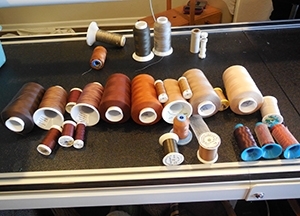
Shiny and dull threads for this horse

Shiny and dull threads for this horse

This week, let’s focus on the stitching of the first horse.

I selected a variety of threads in the full value range.  This first horse is pretty dark, and if I think about what the horse would look like in real life, my thread choices would fall in the medium to dark range.  My analytical brain has to take over to pick the very lightest threads.  Because this horse is standing in water,  a selection of threads with dull and shiny finishes were chosen to differentiate between the wet and dry parts of the horse.

Often, stitching begins with the lightest threads, working toward the dark areas, but this time, I did the opposite. I can’t say why with certainty.  Perhaps it’s because the dark threads will complete most of the stitching and the lighter threads will add the finishing touches.  The first step is to make some broad, sweeping stitch lines to hold things in place.  That is followed by several passes, filling in more and more each time.

These photos show how the work progressed.

Stitching horse 0

Stitching horse 1

Stitching horse 2

stitching horse 3

While working up close, it’s hard to fully appreciate what is happening.  I have to rely on

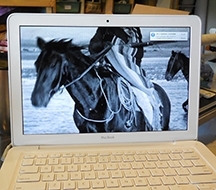
Reference photo on the computer

Reference photo on the computer

what I know should work as I’m stitching.  I also keep my laptop near by with a reference photo on display.  It is always such a treat to step back and look at the work and be able to appreciate that it has come together as planned.  Sometimes, it’s even better, like the stitching along the neck of this horse.  That’s when I smile, pat myself on the back, and say, “Lea, you’ve done well.  You should have some chocolate.”

After a cup of tea and a few Thin Mint cookies, I had to admit that I was not thrilled with the nose.  More on that next week…

Share