Monthly Archives: May 2021

3 possible ways to create a color scheme with 5 colors

How to Create a Color Scheme That Works

A balanced color scheme is a key component of a successful art quilt, or any other artistic endeavor. I have a method to create a solid scheme, identify a missing color, or fix a scheme that doesn’t work. I discussed this topic in my most recent Color & Composition class and share a summary of that information here.  If you are intrigued,  information about future Color & Composition class sessions can be found at the bottom of this article.

Create a Color Scheme with Reflective Symmmetry

The color wheel is an essential tool in this process.  Most come with features that prompt various color schemes using triangle, rectangle, or square shapes.

close up of 2 color wheels showing color scheme guides

Color scheme guides on color wheels

A common feature of each of these shapes is that they have reflective symmetry; also referred to as bi-lateral symmetry.  This means that you could draw a line through the shape so that one side is the exact reflection of the other.  You could fold that image on the line and have both halves match exactly.

Triangle, rectangle, and square shapes with line of symmetry.

Shapes with Reflective Symmetry

Create a More Colorful Scheme

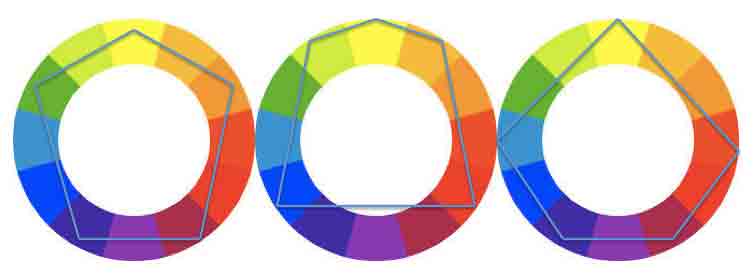
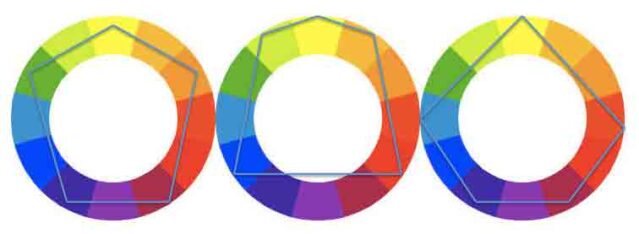
It is possible to stretch beyond the standard color schemes, and still maintain harmony and balance. The key is to use colors that create a shape with reflective symmetry.  For example, when using 5 colors, think of a simple house shape.  Make your dominant color the peak of the roof.  The next 2 colors will be the corners where the roof turns into walls, and the final 2 colors will be the base of your walls.

3 possible ways to create a color scheme with 5 colors

Variations of a 5-color scheme

The colors may not be evenly spaced, but, if the guiding shape has reflective symmetry, you will create a scheme that has harmony and balance.

Complete, or Fix, a Faulty Color Scheme

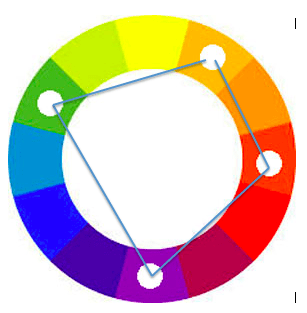
Maybe you have a set of colors that are must-haves in your quilt project, but you want to be sure that the overall scheme is solid.  In my example below, I’m starting with an ugly fabric that has sentimental meaning.  To begin, I place markers on the color wheel to indicate the colors in this fabric. In this case my colors are violet, red-orange, yellow-orange, and these do not create a shape with reflective symmetry.

color wheel shows unbalanced scheme of yellow-orange, red-orange and violet

ugly fabric color scheme is asymmetrical

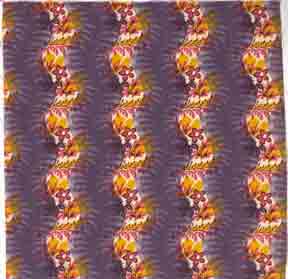
Ugly fabric with undulating purple stripes alternated with curved stripes of gold and red flowered vines.

Ugly fabric


Add a fourth color to create a color scheme that has balance and harmony.  Here are 2 possible options.  First, adding blue to the scheme will balance it.


create a balanced color scheme by adding blue to create a trapezoid.

Add blue to create a trapezoid.


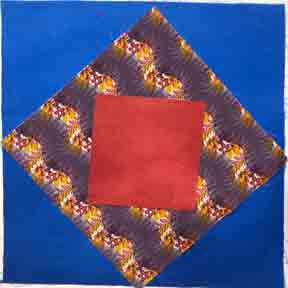
fabric swatches show color scheme that adds blue to the ugly fabric

Fabric Swatches show blue in the mix.

Replace blue with green to create another balanced color scheme.

create a balance color scheme by adding green to the mix

Option 2: add green to the scheme

fabric swatches show green with ugly fabric

Add green to the mix.

Make the scheme more complex by adding both blue and green.  This will also create a pentagon shape on the color wheel; and a shape with reflective symmetry.

balanced color scheme with blue, green, violet, red-orange, and yellow-orange.

Balanced Scheme with 5 colors.

create 5-color scheme by adding blue and green to the ugly fabric

5-color scheme that is balanced

Learn More in My Color & Composition Class

Interested in learning more? Every month I lead a Color and Composition class where we explore a color scheme, color concept, and a composition concept.  We meet online  the 4th Saturday of every month 1:00-3:00 PM MDT. To join us, sign up through the Rocky Mountain Quilt Museum.

Subscribe to this blog for future summary updates on topics covered in the Color & Composition class.

Share
Use calipers to measure sashing and first border.

Quilt Borders and Sashing Using the Golden Mean

The Golden Mean and Calipers

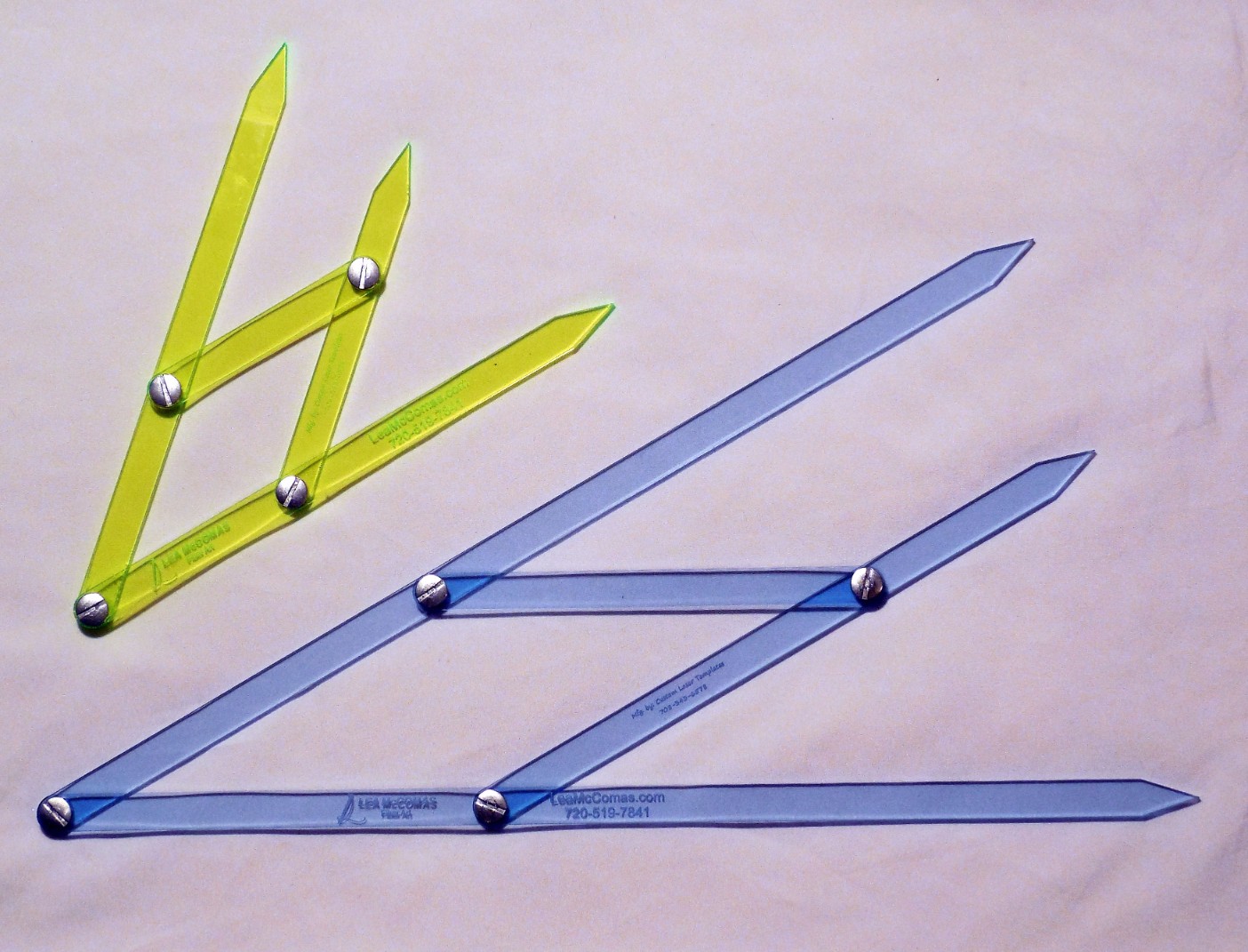
Finding the perfect width for your quilt’s borders and sashing is easy if you use the Golden Mean.  If you aren’t familiar with this term, it refers to a sweet spot in the middle, between 2 extremes.  It divides a space so that one side is a bit larger than the other in a way that is harmonious and pleasing to the eye.  Also referred to as the golden ratio, it occurs often in nature.  To find this division of space, I love to use my Golden Mean Calipers.  As the calipers open and close, the center point, always indicates the Golden Mean, and two harmonious inner spaces.  

large and small Golden Mean Calipers

large and small Golden Mean Calipers

These calipers are available in the Creativity Tools section of my web store.

Perfect Borders Using the Golden Mean

Adjust the Golden Mean Calipers to measure the width of a quilt block

Measure the width of your block.

This tool is also useful when adding borders to a traditional block quilt.  One method is to start with the blocks themselves.  Place the outer points of the calipers at the edges of the blocks.  This will give you two new measurements that will be in harmony with the blocks. 

Use the larger measurement for the total width of the border. 

Use the larger of the 2 inner golden mean measurements for the finished width of the full border.

Create a single border matching the wider measurement of the calipers.

Divide this area further by placing the outer points of the calipers on the edges of the border area.  This will indicate pleasing widths for an inner and outer border. 

Divide the border area using the calipers.

The golden mean indicates the optimum width of borders and sashing.

Create harmonious smaller borders.

All measurements indicate finished sizes, so don’t forget to add seam allowances.

Perfect Sashing Using the Golden Mean

Use the golden mean to determine the width of sashing, as well as borders.  The smaller inner border width, determined above, is also the perfect width for sashing.  Sashing is used  between and around all of the blocks, and it serves to set the blocks apart for the purpose of highlighting each as an individual unit.

Borders surround the grid of blocks and visually hold them together.  Sashing adds to the visual weight of the grid layout, and creates the need for a larger border to maintain balance. Combine the width of the sashing and the single border to create a harmonious, larger, outer border, as shown below.

Use golden mean calipers to measure sashing and first border.

Measure sashing & border

Golden Mean Calipers indicate width of an additional border

Calipers indicate width of additional border

Borders and Sashing for a Predetermined Quilt Size

Sometimes, a specific finished size is necessary and the process described above will exceed those limits.  In this case,  if you know how wide the full border needs to be, but you want to break it down into multiple borders, the golden mean is a good way to do that.  Open the calipers to the full border width, and use the two inner measurements for multiple border widths.

No calipers – No Problem

You can also determine harmonious measurements without the calipers by using the magic number: 1.6.  Take any measurement.  Determine a larger size by multiplying by 1.6

Example: 5 x 1.6 = 8 

Conversely, divide by 1.6 to find a smaller measurement.

Example: 5 ÷ 1.6 = 3.125 (Round down to 3 inches)

Learn More in My Color & Composition Class

Interested in learning more? Every month I lead a Color and Composition class where we explore a color scheme, color concept, and a composition concept.  We meet online  the 4th Saturday of every month 1:00-3:00 PM MDT. To join us, sign up through the Rocky Mountain Quilt Museum.

Subscribe to this blog for future summary updates on topics covered in the Color & Composition class.

Share
Malala shown walking forward wearing a golden kaftan with a red scarf.

Malala Does the Women’s Work of Educating Girls

Malala Yousafzai appears on the Women’s Work quilt for her efforts in educating girls.  Find her at the center front of the quilt, walking hand in had with a young Ruby Bridges. Together, they represent the long struggle to provide education to those denied based on race, gender, or ethnicity.

Educating Girls: a Family Priority

Malala Yousafzai was born on July 12, 1997, in Mingora, a town in the Swat Valley of northwest Pakistan.  Her father, Ziauddin Yousafzai, and mother, Tor Pekai Yousafzai were Sunni Muslims. They named their first child, Malala, after a famous female, Afghan warrior. Malala’s parents vowed to provide their daughter with the same opportunities traditionally allowed only to sons. 

photo of the girls attending the Yousafzai school for girls. Her father, center back placed a high vale on educating girls.

Yousafzai school for girls

Malala’s  father and grandfather were educators, and her parents valued education for all children.  They owned and ran several private schools, some for boys, and others for girls.  Malala’s father recognized early on that his daughter had an exceptional mind.  He sought to grow her curiosity, and would allow her to stay up after her younger brothers went to bed.  They talked about politics and other important issues of the day.

Taliban Outlaws Educating Girls

The Taliban, an Islamic fundamentalist group, took control of the Swat Valley in 2007.  They

School destroyed by the Taliban

School destroyed by the Taliban

sought to impose Sharia law, a very strict interpretation of the religious principles put forth in the Quran, and they imposed harsh and extreme punishments. This included bans on many forms of entertainment, including radio and television. The Taliban forbade men to trim their beards, and they executed, or amputated the hands of barbers who performed this service.  The Taliban beheaded their opponents and put the bodies on public display. They also banned the education of women and girls.

In January 2008, the Taliban shut down schools for girls and destroyed many of the buildings.

Malala gave her first public speech asserting the importance of educating girls in September of 2008 when she was only 10 years old. Speaking before a regional gathering of newspaper and television journalists, she declared, “How dare the Taliban take away my basic right to education?” She was young, but her work as an activist had begun.

Fierce Educational Activists

Malala’s father was an activist with a strong belief in finding peaceful solutions. He encouraged her to become involved in organizations that promoted educational instruction, encouraged public debate, and journalistic freedom related to social issues.  She remained a vocal critic of the ban on education for girls. At age 11, she connected with the BBC and began a blog that described life for ordinary people under the harsh rule of the Taliban.  To protect her, this work was published under the pseudonym “Gul Makai,” the name of a heroine of a Pashtun folktale. She and her family could have been killed if her true identity was known.

Malala’s blog ended suddenly in March 2009 when her family was forced to flee the region. Her father spoke out against the Taliban, and in response, they broadcasted death threats to her father over the radio.  The family returned to their home later that year, after the Pakistani military was able to push the Taliban from the cities and regain some control of the region.

Attempted Murder

Malala continued to advocate for educating girls through her associations with a number of child advocacy, and female empowerment organizations, and gained international recognition for her work. Archbishop Desmond Tutu nominated her for the International Children’s Peace Prize.  Finally, in 2012, Taliban leaders, offended by her words and actions, decided that she needed to be silenced.  On October 9, 2012, a masked gunman boarded her school bus, shot Malala in the head, and then disappeared into a crowd.

International Outrage and Support

The event shocked the world and prompted international outrage. Protesters took to the streets in many

Malala with her Nobel Peace prize

Malala with her Nobel Peace prize

Pakistani cities.  Celebrities, government leaders,, human rights and women’s groups, from around the world issued scathing rebukes of the attackers.  Fifty Muslim clerics in Pakistan issued a fatwa against the men who had organized the attempted assassination. 

In response to this, the Taliban released a statement naming Malala a “symbol of the infidels and obscenity” and vowing that, if she survived, they would target her again.

Although seriously injured, Malala did not die. Doctors treated her locally, before transferring her to Germany, and then to the United Kingdom where she received treatment in Birmingham England. She underwent multiple surgeries and intensive physical therapy over the next two years. Eventually, her family also relocated to England for their safety. 

Malala Becomes the Educated Woman

 Malala could have recovered and faded into relative obscurity, but instead, she chose to continue her campaign for the education of girls. She co-founded the Malala Fund, an organization dedicated to ensuring that girls around the world have an opportunity to learn and become leaders.  For her work, she received the Nobel Peace Prize in 2014. At age 17, she became the youngest recipient of this award.  Malala completed high school in England and went on to study at Oxford.  She completed a Bachelor of Arts degree in Philosophy, Politics, and Economics in June 2020.  It is not safe for her to return to her home country of Pakistan. There are still many Taliban supporters and sympathizers that would seek to harm her. Now, she has become a citizen of the world. 

Malala Fund for Educating Girls

For Malala, educating girls continues to be a priority.  The Malala Fund supports education advocates and activists who are challenging the policies and practices that prevent girls from going to school in their communities.  Some examples of their work:

-They are using technology to give Syrian refugee girls access to classrooms they are not allowed to physically attend.  They are also working to reduce child marriage. 

-In Nigeria they are helping girls living under the threat of Boko Haram complete their education. 

-In Brazil, they are ensuring schools reach the most marginalized girls.  And they are training young women to speak out for their rights. 

-In Pakistan, they continue to fight for education funding that will guarantee 12 years of school for girls.

My Personal Take Away…

Portrait of Malala wearing a red scarf. Negative space is created with a white background. A Islamic floral border of blue and red flowers with green leaves. The center text is a quote by Malala Yousafzai, "With guns you can kill terrorists, with education you can kill terrorism.

Malala, by Lea McComas, 30″ x 50″, 2019.

I’ve been a teacher for almost 40 years, and I know firsthand the power of education.  I love how the actions of the men who sought to silence Malala, actually, amplified her voice so that she could be heard around the world.  I celebrate Malala for standing up to her oppressors, and for the journey she has taken since that fateful day on the bus.  In 2019 I was invited to make a quilt for the Better World quilt exhibit celebrating heroes working for the greater good.  I chose Malala as the subject of my quilt and included one of my favorite Malala quotes, “With guns you kill terrorists, with education you kill terrorism.”

You can be a part of this important global movement for women’s equality. Please visit Malala.org to see how you can be involved.

See the Women’s Work Quilt

 The Women’s Work Quilt will debut as a featured work in the exhibit Women’s Voices, Women’s Votes, Women’s Rights, at the Clinton Presidential Library, in September 2021.  Look for more details on the Events page of this website.
Share