Monthly Archives: December 2014

Sharing Student Successes

The reward of being a teacher is to experience the success of one’s students.  In recent weeks, I’ve been sent photos of finished work from several students.  Some of these photos have come from other states and other continents.  The magic of the internet is that it bridges great distances.  Below, please enjoy some of the work that others have done using my lessons on fused appliqué.

Work by Paula Tuaño, Bayberry Quilters of Cape Cod (disregard the dates in the corners of the photos.)

Asleep in the Car

Asleep in the Car

Three Bums from South Ferry flophouses,  Battery Park, NYC 1941

Three Bums from South Ferry flophouses,
Battery Park, NYC 1941

Work by Joan Musick, Colorado Springs

Oscar

Oscar

detail of Oscar

detail of Oscar

Work by Marie Glover, Yeelanna, South Australia

title unknown

title unknown


Portrait Quilt by Marie Glover,

Portrait Quilt by Marie Glover,

Thanks for sharing, ladies.

Share

I’m Making Water

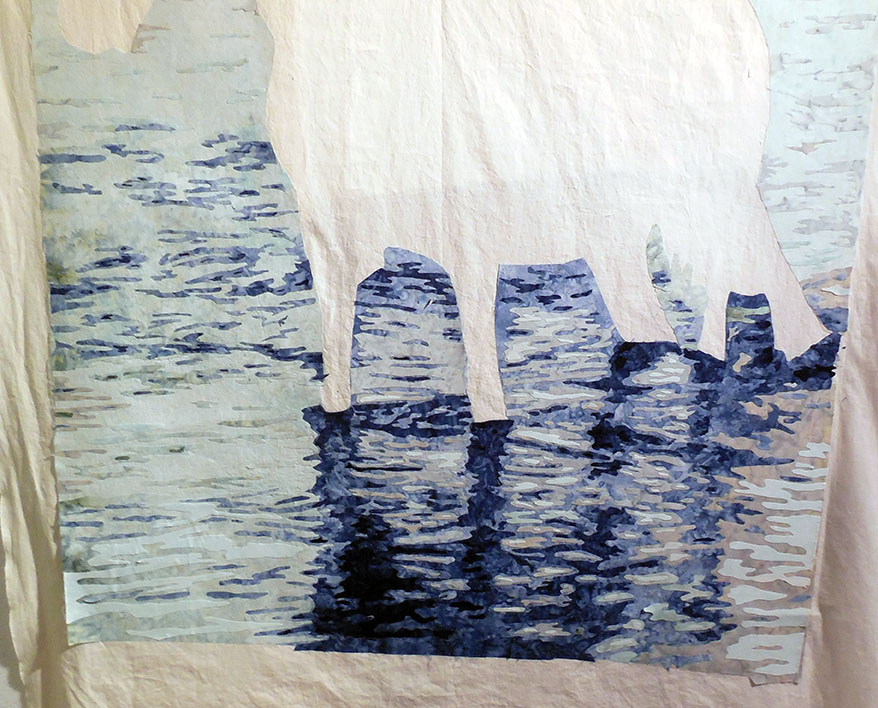
Finally, it’s time put start fusing fabric.  For my next piece, The Four Horsemen”, I’m starting at the bottom and working my way up.  That means creating the river that the horsemen are crossing.  Hand-dyed fabrics in cool blue and a slightly warmer blue-green are chosen.

water1Looking at the pattern, I see that there is a lot of value change and small pieces needed to get the effect of flowing, swirling water.  After studying the pattern, the best course of action seems to be to establish some larger value areas with big pieces of fabric and then apply smaller lighter and darker pieces over the top.Water 2


The process involves lots of tedious cutting, with sharp curves.  However, it worth it when I step back and can see the pattern of the ripples change as the water flows around the horses legs.  I’m pleased with the contrast of light-dark, and warm-cool.  It’s a good start.water-full


Share

What to do with Leftovers

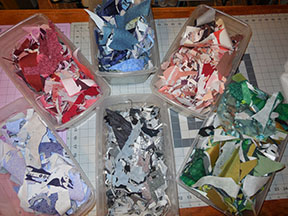
Boxes of leftovers

Boxes of leftovers

Part of preparing for a new piece, is cleaning out the studio to make space for the work. A significant by-product of my process is lots of scrap fabrics with fusible on the back.  These scraps come in unusual shapes and sizes.  I have trouble throwing them away, so I sort them by color and store them in small bins.  After completing Panning for Gold and Bike Boys, my neutral bins were over flowing.  It was time to act.

I sat down with my bins, some fat quarters and leftover pieces of muslin next to the ironing board and began to play.  The rules of this game were to use only the scraps in the bins, to act impulsively, and let ideas develop spontaneously.  There were no patterns, no preliminary drawing, and no end in mind.

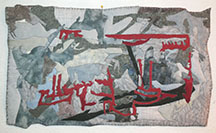
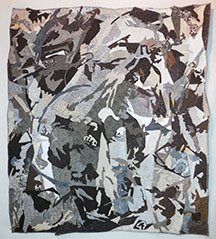
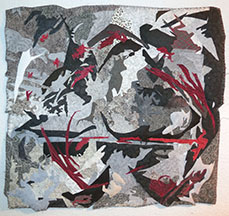
It was quite cathartic, and once I got started, I couldn’t stop.  I created a new series that I now call “Remnants”.  Take a look.


Remnants I

Remnants I

Remnants II

Remnants III

Remnants III

Remnants IV

Remnants IV

Remnants VI

Remnants VI

Remnants V

Remnants V

Share

Embracing Limitations

I shake.  Most notably, my hands shake.   Some days are worse than others.  I have a condition called “Essential Tremor”. The diagnosis came back in the 90’s and after trying a couple of medications with side effects that were worse than the condition, I’ve resigned myself to live with it.

My photo of nephew Jake at his commissioning ceremony.

My photo of nephew Jake at his commissioning ceremony.

The condition has been both a curse and a blessing in my art. The tremor makes it difficult for me to take good photos.  I have a new camera that has an anti-shake feature, but some days, it’s just not enough.  I like to work from my own photos so that I don’t have to worry about copyright issues, but am finding that increasingly difficult.  This is a contributing factor to my working from historical photos.

stitching oops!

stitching oops!

Another reality is that I have difficulty sewing a straight line when stitching with my longarm machine.  If you ever see my work on a traditional quilt design, you would not be impressed.  The up side is that it led me to thread painting.  My style of free-motion stitching doesn’t rely on the same kind of precision.  When it is necessary to be precise with details, I must slow down.  Sometimes, I make one stitch at a time: needle up, needle down, needle up, needle down. Sometimes, I despair, wondering what will happen to my art if and when the conditions becomes worse.

I just found an inspiring TED talk by an artist with a similar condition.  It applies to anyone on a creative journey and I want to share it with you. Phil Hansen TED talk


Share