Tag Archives: art quilts

Adam and the Paperectomy

Finally, it’s time to begin work on the people in this composition.  I’m going back to the beginning, the first image that I fused with

The vest in cool reds

fabric, the man in the background on far right.  Since he is first, I’m calling him Adam.  Because he is a less significant figure, I’m using him as a warm-up to the big buys on the bike.  I started with the vest, using cooler reds than in the bike frame so as to push it into the background,

I move next to the face, again selecting a group of cool grays that will fall back from the warmer tones I will use on the actual bike boys.

The face emerges

Finally, I work on the coat.  This is where I find that the dimensions on the arm are messed up.  I will try to redefine them with thread by making the upper arm wider, and shaving off some of the lower edge of the fore sleeve with darker thread that will put it into shadow sooner.  Check back later to see how this works out.

Got to fix that sleeve

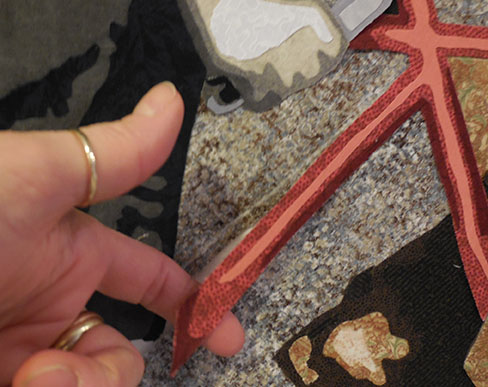
Stitching people is a bit intense. when I have only a short period of time to work and don’t want to dive into the details, I move to the background and begin filling it in.  I discover that this too, presents problems.  While stitching, I begin to hear a clicking noise.  Investigation reveals that I didn’t remove a piece of backing paper before assembling this portion of the work.  I need to go in and get it. I declare the need for a “paperectomy” and prepare for surgery.  See this delicate operation below.  The important thing is to make incisions through the layers at various places.  Once done, I can stitch over the area and seal up the cuts that I’ve made.  The patient will survive with no permanent scars.

Horizontal cut through tulle

Scissors under tulle make vertical cut through fabric.

Loosen and remove paper.

Share

Bike Tire

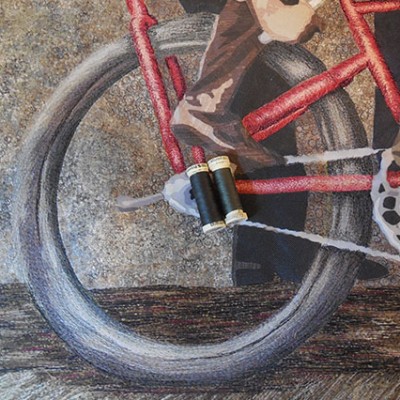
This week, I’ve managed to finish the bike frame and the tires.  I’ve taken a series of photos of the back tire to show how I progress from the lightest threads to the darkest, and then add accents (bits of black) and highlights (bits of white).  Aside from the white and black, I used 4 values of thread, but chose 2 threads for each value.  One was slightly warmer and the other cooler.  I’ve set up my threads and a reference photo on the laptop.  Now, I’m ready to get started.

I work my way around the tire using both threads of each value, but use more of the warmer thread in the back, lit part of the tire, and more of the cooler thread in the front, or shaded side of the tire. Here is how it went.

scissors point to trouble spot.

On may way around I discover trouble: the lines of the tire don’t line up well as they appear between the parts of the frame.  I’ll have to keep this in mind and make some corrections with the darker threads.

I use the mid-value threads to blend the edges of the tire trouble spots with the background.

scissors point to blending away of bad edges

I use the darker threads to redefine the edges so that they line up.

edges redefined

Now, I consult my photo from several weeks back showing the strings.  I use this to select key spots to add white and black to create highlights and accents at just the right spots. (see blog from 3/1/2014).

A mere four hours later, and it’s all done. Hmmm, what to tackle next…


Share

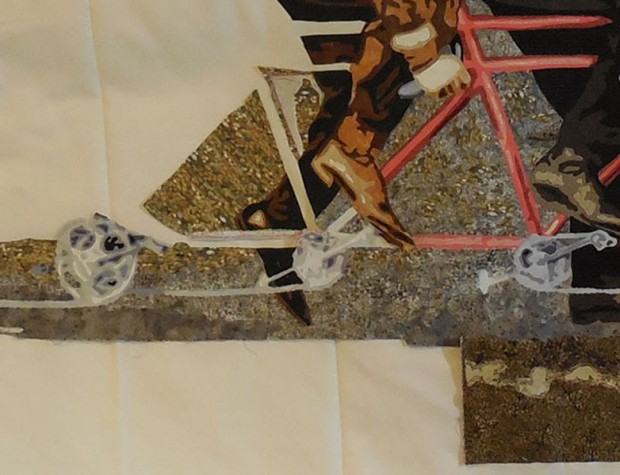
Stitching the Frame

I’ve stitched the mid and foreground sidewalk and street.  This involved a lot of circular stitching.  I like to use variegated threads for this kind of stitching because they blend easily and create variation on the surface.  

After that I started stitching the bike frame.  This takes a bit more attention.  I chose 10 threads total that range from very light to very dark,  I put down the middle value thread first and then worked to the lightest thread.  Now, I need to go back and put down the darker threads, and do some fine tuning.  A key factor will be breaking up the highlights and the accents so that they come and go.

Share

Bike Boys Ride a New Machine

After a week of taking care of other responsibilities, I’m back to work on the Bike Boys.  Today I loaded them on the long arm quilting machine.  This was no small task since pieces are still coming loose.  

In addition to the backing and batting, I’ve inserted a layer of painters canvas under the Bike Boys appliqué.  This will help to stabilize the piece as it is stitched.  A layer of fine tulle netting goes over the top.  This will keep all of those raw edges from getting fuzzy and will help to hold the small bits in place as I stitch.  Because of the difficulties with the fusible, I did not wrap the the appliqué layer around the bars of the frame.  I was afraid it would all come apart.  

The most time-consuming part of the process is getting rid of all those little bits of thread and fluff.  I have to carefully run a lint roller over the surface, and then over the tulle.  The tulle seems to have a lot of static electricity so things keep jumping back on to it.  

Finally, it is all pinned in place and lint free.  I’ll wrap up this work session by doing some outline stitching around various spots, just enough to hold all the layers in place as I roll the composition back and forth when the real thread-painting gets started tomorrow.

All goes well, until I stand back to appreciate my progress and what do I spot??  Two little what spots of lint trapped under the tulle.  

AAUURGGH!!

Share

Casting a Net Over Bike Boys

While I’m anxious to put the boys on the long arm and begin stitching, there is still some prep work to be done.  I’ve put the piece back on the design wall, put pins at the corners and 1/3 points along the sides.  Next I wrapped string connecting the points and creating a sort of net over the Boys.

These strings are really a network of tangents that run across the surface.  I can use them to identify  lost and found lines that fall on these strings.  I did this a few weeks back when the piece was only partially fused.  Now that it is done, I’ll choose a few key tangents and  accentuate them by stitching highlights and shadows so that they help guide the viewers eye through and around the piece.  Of course this key stitching will be the last stitching that I do on the long arm, but I need to identify these  tangents now, so that I can avoid removing and reloading the piece on the long arm later.

This is also a time to look over the composition and note areas that need some color or value correction.  For example, the bike frame under the front rider’s bum is just a bit too light.  I can cover it with a darker fabric now, or stitch it with darker thread later.  I think it is hard to see in this photo, but the man behind the bike, standing on the sidewalk, should have his feet showing, and they have been done in sidewalk fabric and are obscured.  They sit just on the line going across the bottom third of the piece.  That, I will fix with fabric now, taking care not to make them too strong.

I’ll have to leave this up for a few days and review it several times as it is hard to catch everything in just one viewing.  Do you see anything?


Share

Fully fused–almost

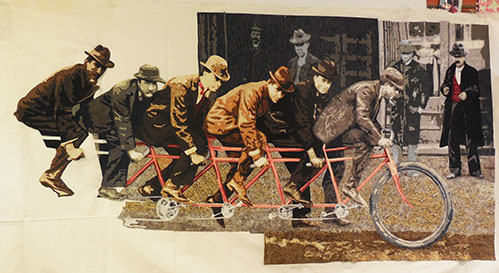
I’ve made huge progress on the Bike Boys this past week.  My goal was to complete the fusing phase of the project.  While the flywheels in the back need some detailing, and one of the pedals has fallen off and gotten lost, the main work is done.  There is enough to look at to make it worthwhile to pin it back up on the design wall and stand back for the full effect.

Having said that, there is still much work to be done.  I’ve already spotted some mistakes.  Can you find them?  And, of course, I’ve got to finish those gears.  I continue to have problems with the fusible not sticking.  At this point, I’ve resorted to glue stick to hold some bits in place.  Moving the piece is being kept to a minimum and I’m a bit worried about what will happen when the whole thing gets wrapped onto the long arm frame.  This will be a busy week , so I’m sure I won’t have to face that reality for another 2 weeks.

Once on the long arm, The stitching will happen in several phases.  First, there will be outlining to hold things in place.  Then, there will be heavy stitching to shade, blend, and contour.  Finally, there will be detailing to accentuate some areas and make them pop.  Stay tuned.  I will guide you through each step.

Share

Bike Boys Surge Ahead

The outer world has settled down and I find myself back in my studio for a long weekend of work on the Bike Boys.   I quickly discovered that time away has doubled the time it takes to get up and running. When working on a piece, there are routines that develop.  When the routines are broken, it takes time to re-establish them.  The second day back in the studio is so much more productive than the first.  I’ve heard other artists speak of the value of practicing one’s art daily.  Today I’m acutely aware of that wisdom.  It’s not so important to produce art, but to be in actively involved in in the process; to stay connected to one’s learning.  I’ve posted a picture of my progress, but the progress viewed is not equivalent to the effort expended.

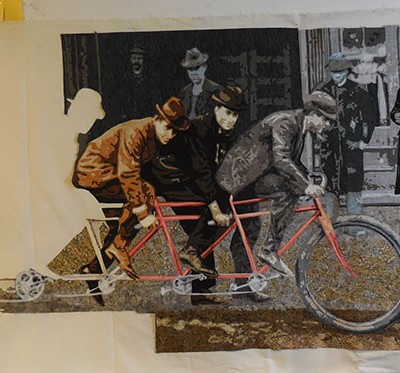
As the bike boys surge forward, a couple of other problems are developing.  First,  in my process, I build the piece by putting together small sections, and then join them to make larger sections, and then put those together on the foundation fabric.  Nothing goes together perfectly and the small imperfections I’m working through at the beginning, compound into 1/8 or 1/4 inch gaps by the far end of the piece.

coming undone

It’s becoming a real challenge to fit everything together which leads to my second problem: the fusible isn’t holding tight.  I’m trying not to be heavy handed with the iron, but after heating, repositioning and re heating, the product is loosing it’s ability to hold.   As the piece becomes larger it’s also becoming more delicate to move around.   I’m hoping that I can get it all together and onto the long arm before it turns into a pile of scraps on the floor.

Share

Bike Boys Going Nowhere

Lea @ Rd 2 CA

It has been an exciting couple of weeks, but I’ve made precious little progress on the bike boys.  Last week I made a quick 5-day trip to London to drop off a couple of quilts and to reconnect with 2 good friends that I met 20 years ago in Turkey.  Of course the days before a trip like that are full of preparation=no quilt work. The trip included high tea at the Goring Hotel, a musical, “From Here to Eternity” at the Shaftsbury Theatre, a new hairdo at the salon in Selfridges, and a bit of shopping on Oxford St. Then, the next couple of days are all about recovery and getting the sleep schedule back in place=no quilt work.

On Tuesday, I received the exciting news that my quilt “Panning for Gold” had won the prize for “Best of Show from a First Time Entrant” at the Road to California Quilt Show.  I’ve never actually been to this show, so I thought this was a great excuse to check in out in person.  Working out travel details and preparing for a substitute teacher at school took up the next couple of days=no quilt work.

With a flight delay, I found myself home with a day to work in the studio.  However, with a deadline looming for the SAQA trunk show, I sprung into action on a different piece: “A Horse of Course”

Me, I’ve been all over the map these last 2 weeks, but the Bike Boys are going nowhere.

Share

Life in the Shadows and the Golden Mean

One line through many elements

With a week off work, my travels over, and all guests have gone home, I’ve been able to make great progress on the Bike Boys.  While traveling, I did pickup some new brown fabrics with deeper, darker shades.  I used them to replace some earlier choices, hoping to strengthen the color schemes for some of the bikers.  I think it worked.  My second bike boy really pops forward.  I also built the foreground with rich tones for the sidewalk and street (you were right, dad), and added the cooler grays for the background.

Originally, I had chosen to delete the figure standing in the large dark space, but when I saw it on the wall, I knew he needed to rejoin the party.  When I added him, I made his features vague and used a very narrow range of value.  This served to push him farther into the shadows and create a third plane within the composition: bikers in the foreground, onlookers on the sidewalk, and this guy in the background. I also raised him up just a bit so that he sits on a tangent in line with other figures in the piece. He will  become the top of a triangular shape within the piece. I pinned the string across the design wall to show this.

Next, I realized that the top of the piece has reached the approximate 2/3 mark.  This got me thinking about the golden mean and how it can be used to create a pleasing composition.  The golden mean refers to a ratio of  3/8 or 5/8, but many people use thirds, because its easier.  If you don’t know about it, it’s worth a google search.  I placed pins at the corners and at the 1/3 marks along the edges and then wrapped string around the pins to create lines joining each of the points.  Placing objects along these lines helps to create a pleasing composition and can be used to guide the eye around and through the piece.  Also, the places where these lines cross could be considered power points.  It was exciting for me to see how often these lines were working with my composition.

So many connections!

 Here are some things to note:

  • the first line crosses the eyes of the man in shadow, then the face of the man behind the bike, grazes the top hat of biker #2, runs along the hat shadow of biker #1, and then connects to the hands of the man inside the window and the man in the red vest.
  • biker #1 is centered within a triangle  created under the 1/3 point and his elbows fall at a power point
  • the face of biker #2 falls at a power point, and so will the face of #3.
  • The tangent that falls through the face of biker #2, hits both elbows of biker #1 before grazing the handlebar and the toe of the red vest guy.
  • The tangent that will cross the hat of biker #3, also flows along the leg of biker #1 and near the bend in the fork of the bike.

I’ve got to take the lines down now so that I can fuse more fabric, but I’ll put them up again when it all comes together.

Share