Monthly Archives: February 2021

Unity & Variety Create Harmony & Interest

Unity & Variety are tools to create harmony and interest in art quilt compositions, and were the elements of composition that  we explored in the last session of my monthly COLOR & COMPOSITION class.  In this  blog I’m sharing some of the highlights of that discussion.

UNITY refers to a relationship between the elements within a composition that bring harmony.  The desired effect is to create the feeling that a work is a single creation with multiple parts, as opposed to, a collection of separate things.

Composition with unity

Round place mat with various items including a plant, fork, pen, latex glove, and pliers.

Composition with disunity

Techniques to Create Unity.

A number of techniques can be used to create unity.

Visual Repetition

Visual repetition is probably the most common way of creating unity.  Repetition gives a

Analogous scheme with blue & yellow parents.

Analogous scheme with blue & yellow parents.

sense of familiarity.  As humans, we prefer familiarity over anomaly.  This can play out in various ways:

Color Scheme– Choosing a scheme brings focus and consistency.  Each color is a part of a larger structure.

Line-Repetition of lines is more than having multiple lines.  It is also about repeating the same kind of line, such diagonal, horizontal, s-curve, or spiral.

Shape:  Shapes can be geometric or organic.  They can vary in size, or color. In eluding multiple versions of the shape creates familiarity and harmony.

Proximity

Placing items near each other creates unity through grouping.  This is where negative space is important.  If you are going to create a space for items to gather, there also has to be a place where they do not gather.  This “negative space” will be a topic in our next Color & Composition session.

Still life composition with potted tree in front of a window next to a trunk covered by a hand women mat. A tin cup and pitcher sit atop the trunk with a small plate with tangerines. One is peeled and divided.

Turkish Treasures Still Life, 2020.

This still life composition was created for an article I wrote for Quilting Arts Magazine (April/May 2020).  It illustrates the concept of proximity.  I communicate that these objects go together by placing them in contact with each other, or overlapping them. 

Simplicity

Eliminate unnecessary elements in a composition so that the focus can be on what is important. Too many different things competing with each other creates confusion and discomfort.

When I teach my portrait class, students work from a photo.  One of the first things I talk about is cropping out anything that is in the background that has nothing to do with the subject.  If it can’t be cropped, then distort, blur, or replace it.  This is what I did in Sweet Song From and Old Fiddle.

Hand holding the neck of a fiddle is visible with a mottled blue-green background.

Detail of Sweet Song From and Old Fiddle, 34″ x 18″, 2013.

Thematic Relationship

You may have objects that don’t share other unifying qualities, but they share an underlying meaning.  A good analogy is the sewing machine: it is made of many different parts, but, put it all together and it it works. Remove a piece, and it doesn’t.

I remember a news report on January 20,  Inauguration Day that featured Donald Trump speaking at Andrews Joint Base in front of 17 American flags.  Apparently, the number 17 was important because Q is the 17th letter of the alphabet, and Q-Anon supporters believed this was a symbol of the revolution to come later in the day.

Consider those elements: American Flags, Letter Q, # 17, Revolution.

Regardless of your political leanings, that those elements were thematically connected, is astounding.—Scary as hell, yet, astounding.

The example I have to share with you is much more benign.  I give you Busy Signal where a cell phone, a hand with wait gesture, and a face cut off below the eyes send a message about communication and connection in our world.
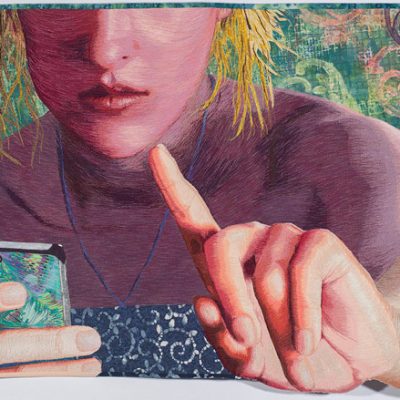
Busy Signal, 25 in x 36, 2017.

Add Variety to Create Interest

Variety-of elements creates interest, breaks the boredom, and adds interest.  Again, there are various ways to do this.

 Altered Repetition

Incorporate an anomaly, a change in the repetition.  In the Circles in Squares example below, all of the elements share a color scheme, and the sizes and shapes are consistent, but offsetting, or slight shifting of elements adds interest.

Circles-in-Squares color study

Interrupt the Pattern

Another option is break a pattern my inserting a another element.  I did this in my tribute to Malala, by placing her image over a large floral border.

Portrait of Malala wearing a red scarf with a white background. A Islamic floral border of blue and red flowers with green leaves. The center text is a quote by Malala Yousafzai, "With guns you can kill terrorists, with education you can kill terrorism.

Malala, by Lea McComas, 30″ x 50″, 2019.

Color & Composition Monthly Workshop

Interested in learning more? Every month I lead a Color and Composition class where we explore a color scheme, color concept, and a composition concept.  We meet online  the 4th Saturday of every month 1:00-3:00 PM MDT. To join us, sign up through the Rocky Mountain Quilt Museum.

Subscribe to this blog for future updates on topics covered in the Color & Composition class.

Share
Shirley Chisolm fabric portrait from Women's Work quilt, front view, wearing lime green dress.

Shirley Chisholm on Women’s Work

Shirley Chisolm fabric portrait from Women's Work quilt, front view, wearing lime green dress, walking down stairs among protestors and legislators

Shirley Chisholm on Women’s Work

Shirley Chisholm(1924-2005) on WOMEN’S WORK, is located at the bottom of the stairs,  wearing a lime green dress.  She is situated between legislators and demonstrators marching forward down the stairs.  Shirley, known as a courageous, and tireless champion for the poor and working class, is famous as the first black woman to serve in Congress.  She was also the first black female presidential candidate from a majority political party. 

Fierce Advocate

Born Shirley Anita St Hill on November  30, 1924 to  Caribbean Immigrants from British Guyana and Barbados, her father was a factory laborer, and her mother was a domestic worker and seamstress.  The family lived in the Bedford–Stuyvesant neighborhood of Brooklyn. Believing it would provide a safer environment, Shirley’s parents sent her and three younger sisters to live with their grandmother on the island of Barbados. The girls lived there for about 7 years.  Shirley attributes much of her success to the early education she received in the traditional British school system of Barbados.  Upon her return to New York City at the age of 10, she performed well in the integrated, but mostly white classrooms.  

After high school, Shirley earned a Bachelor of Arts at Brooklyn College where she also won awards for debate.  Then, she worked in an early child care center, married Conrad Chisholm, and earned her Masters in Elementary Education from Columbia University. She worked her way up to director of the Hamilton-Madison Child Care Center in the 1950’s, and became an educational consultant to New York City’s Bureau of Child Welfare from 1959 to 1964. 

Shirley learned to fight for social justice in her teens from her father who was an active member of a labor trade union.  Her confidence, speaking skills, and grit made her an effective advocate for civil rights, women’s rights, and workers rights.  She was elected to the New York State Assembly in 1965, and became the first black woman elected to the US House of Representatives in 1968.  She served her constituents as a fierce, and vocal legislator. 

Unbossed & Unbought

Shirley’s campaign slogan, “Unbossed and Unbought,” was an apt description.  At first, Shirley

was appointed to the Agriculture Committee.  This was the result of efforts by Southern

congressmen to put her in a place where she would have little influence or power.  Angered, she waged a campaign to be reassigned.  This was unheard-of since freshmen representatives were expected to follow the rules without complaint.  In the end, Shirley got her way, but not before she found a silver lining in agriculture.  In the late 1960’s farmers in the midwest had surplus food that they couldn’t sell.  Shirley teamed with Senator Bob Dole from Kansas and, together, they started what would become the Food Program for Women, Infants, and Children (WIC) to provide food supplements to at-risk women and their infants.

Long desk with 3 black male legislators and Shirley Chisholm sitting behind

Congressional Black Caucus.

During her seven terms in Congress, Shirley successfully helped pass numerous pieces of legislation that gave voice and power to those who were ignored by the government.  She opposed the VietNam War and fought to reduce military spending in favor of increasing funds for domestic social programs. She pushed through legislation that expanded funding for day care and education, and expanded minimum wage protections for domestic workers. In support of women, Shirley hired only females to work in her congressional office, and half of her staff were black.

Presidential Run

Finally, in 1972, Shirley decided to run for President as the Democratic candidate. She became

campaign poster with words Vote for Chisholm, Unbossed and Unbought. Shows image of Shirley Chisholm speaking

Campaign Poster

the first black candidate from a major party, and the first woman Democratic party candidate.  A major obstacle for her campaign, were the black male colleagues within the party.  Shirley claimed that she faced more discrimination for being a woman, than for being black. Winning the nomination was a long shot, but, Shirley hoped to amass enough support to be able to influence the party platform. She planned to demand a black vice-presidential candidate, and insist on diversity in cabinet, and agency appointments.

Shirley invited all to “Join me on the Chisholm Trail” as she campaigned across the country on a shoe-string budget, and heavy reliance on volunteers. Her policy positions included support for:

  • Anti-poverty legislation

    Shirley Chisholm behind lecture, speaking at convention

    Shirley speak at Democratic Nat’l Convention

  • Ending the VietNam war
  • Abortion rights
  • Gay rights
  • National health insurance
  • Legalization of marijuana
  • Fair housing laws
  • Busing as a temporary means to desegregate schools

Shirley built a broad coalition of supporters, but, she did not win the nomination. She did, however, come in 4th in a field of 15 candidates at the Democratic Convention.  She inspired women worldwide, and was voted as one of the 10 most admired women in the world.  After the election, Shirley returned to Congress where she served another 10 years.  In retirement, she remained involved in many political organizations, spoke at colleges to encourage student activism, and continued to fight for women’s rights.  

What about those demands at the convention…

In her run for president, Shirley hoped to gain the clout to demand a black vice presidential running mate, and diversity in cabinet and agency appointments.  That was in 1972.  Not until the election of Joe Biden and Kamala Harris in 2020, nearly 50 years later, did those demands became a reality.  At the inauguration ceremony, Harris wore purple as a tribute to Shirley Chisholm whose campaign colors were purple and yellow.

My take away…

The pace of equality is much too slow.  In researching Shirley Chisholm, I must confront the question, “What are you doing about it?”.

As a high school teacher, I work with many students from marginalized groups: young women and children of immigrants.  They often do not have a family history of education or activism, so, I try to plant those seeds.  I challenge students to be the first in their families to graduate from high school, to set a goal of attending college, and to register to vote. These steps can change the path of an entire family for years to come.

girl standing, inserting ballot into collection box outside in snow storm

1st Time Voting

In the 2020 election, a former student contacted me because she wanted to vote.  She didn’t know how, and no one she knew had ever voted in a US election.  Over the phone, I talked her through the registration process.  When her ballot arrived, I explained each of the issues, and shared a booklet from the state voting commission with more information.  After talking her through marking and sealing her ballot, I drove her to the drop-off site and told her, “Next time, bring two friends and we’ll do this again.”

See the Women’s Work Quilt

See Ida B Wells on Women’s Work in person. This quilt will debut as a featured work in the exhibit Women’s Voices, Women’s Votes, Women’s Rights, at the Clinton Presidential Library, in September 2021.  Look for more details on the Events page of this website. Follow this blog for more stories of amazing women. Follow this link to see more of Lea’s Portrait Quilts.

Learn More About Shirley Chisholm…

Michals, Debra.  “Shirley Chisholm.”  National Women’s History Museum.  2015.  www.womenshistory.org/education-resources/biographies/shirley-chisholm. 

History, Art & Archives, U.S. House of Representatives, ““Catalyst for Change”: The 1972 Presidential Campaign of Representative Shirley Chisholm,” https://history.house.gov/Blog/2020/September/9-14-Chisholm-1972/(January 30, 2021)

Shirley Chisholm: First African American Congresswoman (March 31, 2020).  Timeline-World History Documentaries.  https://www.youtube.com/watch?v=Fz-dfJIprkY

Shirley Chisholm Biography, Encyclopedia of World Biography, (January 30, 2021). https://www.notablebiographies.com/Ch-Co/Chisholm-Shirley.html

Dovid Zaklikowsk (January 20, 2021)  Turning Disappointment Into Food for the Hungry. The Rebbe.org. https://www.chabad.org/therebbe/article_cdo/aid/558041/jewish/Turning-Disappointment-Into-Food-for-the-Hungry.htm

History.com Editors (December 10, 2020). Shirley Chisholm. A&E Television Networks.  https://www.history.com/topics/us-politics/shirley-chisholm


Share
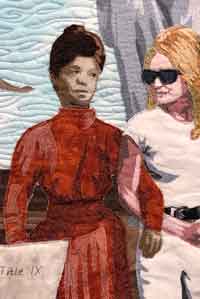
Ida B Wells portrait in fabric on the quilt Women's Work. Ida is wearing orange dress typical of 1940's. Her hair is in a know on top of her head. She is arm in arm with Gloria Steinem.

Ida B. Wells on Women’s Work

Ida B. Wells (1862–1931appears on Women’s Work on the main level of the quilt, walking arm in arm with Gloria Steinem.  She is included because of her contributions as a journalist, and is notable for her investigative reporting on lynching in America.

Ida was born to slave patents in Holly Springs, Mississippi on July 16, 1862.  However, at the age of 6 months, she and her family were freed by the Emancipation Proclamation.  Following the civil war, her parents were active in Reconstruction.  Her father joined the Freedman’s Aid Society and helped start

head and shoulders sketch of Ida B Wells, circa 1940.

Journalist, Ida B Wells. Circa 1940.

 Shaw University.  This school for newly freed slaves is where Ida received her early schooling.

At age of 16, Ida lost both parents and an infant brother in a Yellow Fever outbreak.  As the oldest, she had to care for younger brothers and sisters. So, she convinced a local school administrator that she was 18 and was hired as a teacher. Over the next few years, Ida arranged for her brothers to work as carpenter apprentices, and moved her sisters to live with an aunt in Memphis, Tennessee.  Ida returned to college and honed her journalistic skills at Fisk University and continued to work as a teacher.

Injustice in the South

In 1884, Ida bought a first class train ticket in Memphis. She boarded the train, but was denied a seat in first class.  The conductor told to sit in the car reserved for blacks.  Ida refused and an argument ensued.  The conductor and fellow passengers forcibly removed her from the train.  Ida sued the train company and won a $500 settlement in a circuit court.  On appeal, the Tennessee Supreme Court overturned the ruling, and charged Ida for court fees.  Outraged, she channeled her energy into several editorial articles published in black newspapers.  Using the pseudonym “Iona,” she criticized Jim Crow laws and treatment of blacks in the south.  Eventually, Ida owned and published her own newspaper, Free Speech, in Memphis.

In 1892, three balck men opened a grocery store in Memphis.  Their success drew customers from the white owned store across the street. One night, a group of white men gathered to vandalize the store.  In defending the shop, several white men were shot and injured.  Officials arrested the black store owners.  Later that evening, a white mob took them from their cells and hung them.

Investigation of Lynching

Outraged by the death of her friends, Ida carried out her own investigation of

Cover of book The Red Record by Ida B Wells, showing image of a lynching party.

The Red Record, documents lynching in America

lynching in the South. First, she published her findings in a pamphlet titled Southern Horrors. Later, she traveled to give lectures and wrote a book, A Red Record, detailing the treatment of blacks in the south.   She documented the practice of lynching black men who challenged the authority of whites, or dared to be successful in politics, or business. Using her words, she effectively painted a picture of conditions for blacks in the South.  In a speech she delivered in Boston on February 13, 1893, Ida reported, 

…since invested with citizenship, the race has been indicted for ignorance, immorality and general worthlessness declared guilty and executed by its self constituted judges. The operations of law do not dispose of negroes fast enough, and lynching bees have become the favorite pastime of the South.

The brutal honesty of her reporting angered whites who descended on her newspaper office, destroyed the presses,   The mob proved her words correct when they threatened to kill her if she returned to Memphis.  Ida escaped to England where she continued her anit-lynching campaign, and brought international attention to racial injustice in America.

In 1895, Ida returned to the US, settled in Chicago, and married Ferdinand Barnett, a lawyer and newspaper editor. Together, they raised 4 children and continued to fight social injustice on many fronts. Ida was active in several social justice issues, including women’s suffrage, and equal education for blacks.  She was a co-founder of the National Association for the Advancement of Colored People (NAACP). Ida continued to write and lecture in the US, and abroad, until her death in 1931.

The False Characterization

Ida’s investigative reporting  uncovered a common justification for lynching. Whites  justified the murder of black men with the assertion that those men would sexually assault white women. Essentially, whites believed that lynching was necessary to protect the virtue of their wives and daughters. 

It is important to note here, that multiple sources, over many decades, consistently show that sexual violence data, disaggregated by race, shows that perpetrators are most likely to be white. In fact, sexual violence by whites occurs at a level of more than double that of blacks. For current statistics visit the Rape, Abuse & Incest National Network website: RAINN.org.

My personal take away…

The research for Ida B Wells on Women’s Work led me to a startling realization.  The false notion that black men are inherently “dangerous” exists in my own consciousness. Growing up in a white suburb of Kansas City, I had very few interactions with blacks, so how did I learn this? Upon reflection, I realized that the lessons were part of my growing up. For example, when my family drove into the city, through predominantly black sections of town, my parents instructed us to lock our doors. Now, in my 50’s, I’m adamant that I’m not racist.  However, driving through Denver, the thought that I should lock my car door sometimes pops into my mind.  Those irrational ideas still echo in my head.  Because I’m aware, I will stop it, and I’ll speak up when others perpetuate that idea.

See the Women’s Work Quilt

See Ida B Wells on Women’s Work in person. This quilt will  debut as a featured work in the exhibit Women’s Voices, Women’s Votes, Women’s Rights, at the Clinton Presidential Library, in September 2021.  Look for more details on the Events page of this website. Follow this blog for more stories of amazing women. Follow this link to see more of Lea’s Portrait Quilts.

Learn more about Ida B. Wells…

Biography.com Editors (2020, June 24). Ida B. Wells Biography. A&E Television Networks and the Biography.com website. https://www.biography.com/activist/ida-b-wells

Norwood, Arlisha (2017). Ida B. Wells-Barnett. National Women’s History Museum.  www.womenshistory.org/education-resources/biographies/ida-wells-barnett.

Steptoe, T. (2007, January 19) Ida Wells-Barnett (1862-1931). BlackPast.org. https://www.blackpast.org/african-american-history/barnett-ida-wells-1862-1931/ 

Editors of BlackPast.org (2007, January 29). Ida B. Wells, “Lynch Law In All Its Phases” transcript of speech delivered at Boston’s Tremont Temple on February 13, 1893,as published in Our Day magazine, May 1893.  BlackPast.org. https://www.blackpast.org/uncategorized/1893-ida-b-wells-lynch-law-all-its-phases/ 

Ida B Wells, The Red Record Lynching in the United States. Available free through pdfbooksworld.com. https://www.pdfbooksworld.com/The-Red-Record-by-Ida-B-Wells-Barnett

Wells-Barnett, Ida B., “Southern horrors : lynch law in all its phases,” Digital Public Library of America, http://dp.la/item/3f4d5d3a67f8ce16f1b00b3cb01dc143

Ida B. Wells, head-and-shoulders portrait, facing front. , None. [Between 1940 and 1960?] Photograph. https://www.loc.gov/item/2009633545/.

Share
Bamboo by Lea McComas, features echo images of bamboo in analogous color scheme of yellow-green, green-blue-green.

Analogous Color Schemes Create Harmony

Analogous Color Schemes were one of topics discussed in my last

online Color & Composition class.  I hope the information presented here will inspire you to explore this color scheme. If you find this helpful, and want to join me for the next session, you will information at the bottom.  

Analogous color schemes include a run of colors next to each other on the color wheel.  These schemes can include 3, 5 or 7 colors. They work best when built around primary colors.  Like a monochromatic scheme, analogous schemes are great for conveying strong emotion. They also have

Analogous Scheme with mother Yellow.

Analogous Scheme with mother Yellow.

greater potential for energy and interest.  

 Analogous is a word that references a collection that has something similar, or a direct connection that applies to each element. The strong relationship among the colors in this scheme creates a sense of harmony.  There is a kind of kinship.

Analogous run with 7 colors

Analogous run with 7 colors

Analogous Colors Schemes are like Families.

One way to build analogous color schemes is to begin with a primary

Analogous scheme with red mother

Analogous scheme with red mother

color.  Think of this as the mother, and then expand to include the color, or child,  on each side.  Expand the scheme further to 5 colors by including the father of each child.   In this analogy, it is easy to understand that managing the harmonious effect of this scheme becomes more challenging, as the family gathering expands.

Analogous scheme with 2 primary parents

Analogous scheme with 2 primary parents

Another way to build analogous color schemes is to choose two primary colors.  Think of these as parents.  Then, include all of the children, or colors, in between.  Reduce the color scheme to 3 colors by eliminating the parents and using  just the siblings,. 

In either case, the scheme can be expanded further to include 7 colors. However, expanding this much requires incorporating a set of direct complements. Direct complements bring a lot of energy. That drama can disrupt the family harmony. Think of these as the mother-in-laws.

Analogous run with 7 colors

Analogous run with 7 colors

No Sleepy Schemes

With the colors being so close on the color wheel, analogous color schemes have the potential to be a bit boring, or sleepy.  Increase variety within the scheme to combat this.  One way to do this is through an expanded scheme.  The advantage of a 5-color scheme over a 3-color scheme is the ability to increase the color contrast.   Look at the examples below.

fabric swatches for 3-color scheme

fabric swatches for 3-color scheme

fabric swatches for 5-color scheme

fabric swatches for 5-color scheme

Another strategy is to emphasize one color within the scheme over the others.    Any color within the scheme can be the star of the show.  However, luminous colors, such as yellow, will naturally want to be the center of attention. Manage the scheme by using purer hues, and more intense versions of the color to be emphasized. Likewise, use more tints, tones, shades, and less intense version of the other colors.

3 Analogous Experiments

I spent a day experimenting with various analogous color schemes. Working with 5 colors, I chose a hue, tint, and shade of each color, and then mixed in  a collection of neutral gray fabrics.  In each experiment I created 48 half square triangle blocks and then arranged various compositions on the design wall.

Experiment 1: Mother Red

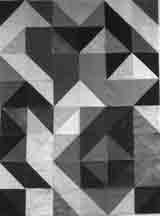
This analogous run stretched from violet to orange.  Here was my final composition. The grayscale image shows how value is also at play.

Analogous scheme built around red.

Analogous scheme built around red.

Grayscale view of Red analogous scheme.

Grayscale view of Red analogous scheme.

Experiment 2: Parents Blue and Yellow

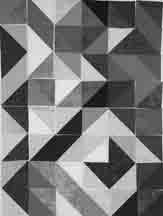
Here is my analogous run with two primary parents and their children. The grayscale image is also included.

Analogous scheme with blue & yellow parents.

Analogous scheme with blue & yellow parents.

Grayscale view of Yellow-Blue scheme.

Grayscale view of Yellow-Blue scheme.

Breaking the Rules

What happens when the analogous color scheme is built around tertiary colors, instead of primaries? 

In my third experiment, I built a scheme with blue-violet as the central color, stretching from red-violet to blue green.  Using the family analogy, this is like loosing the parent red at one end of the run, and bring in the mother-in-law at the other end of the run. My results were less than ideal, but not a total disaster. Blue-green definitely feels like an outlier in this scheme.  It is the only color with a touch of yellow.  See my results below.

Scheme based on tertiary colors

Scheme based on tertiary colors

Grayscale view of tertiary scheme.

Grayscale view of tertiary scheme.


In the next Color and Composition class we’ll delve deeper into the analogous color scheme and take a look at an Accented Analogous Scheme.  We meet on the 4th Saturday of every month 1:00-3:00 PM MDT. To join us, sign up through the Rocky Mountain Quilt Museum.

Subscribe to this blog for future updates on topics covered in the Color & Composition class.


Share