Category Archives: Uncategorized

A Horse of Course

I’ve been away from the blog for a while, but, as you might have guessed, progress did continue on the horseman.  In my race to finish it in time to submit to the Houston quilt competition, all available resources were diverted to making progress on this piece.  I did take some photos along the way and will share that progress with you in my next few blog posts.
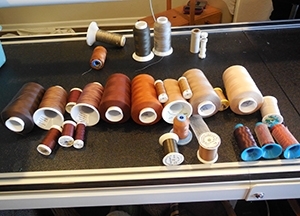
Shiny and dull threads for this horse

Shiny and dull threads for this horse

This week, let’s focus on the stitching of the first horse.

I selected a variety of threads in the full value range.  This first horse is pretty dark, and if I think about what the horse would look like in real life, my thread choices would fall in the medium to dark range.  My analytical brain has to take over to pick the very lightest threads.  Because this horse is standing in water,  a selection of threads with dull and shiny finishes were chosen to differentiate between the wet and dry parts of the horse.

Often, stitching begins with the lightest threads, working toward the dark areas, but this time, I did the opposite. I can’t say why with certainty.  Perhaps it’s because the dark threads will complete most of the stitching and the lighter threads will add the finishing touches.  The first step is to make some broad, sweeping stitch lines to hold things in place.  That is followed by several passes, filling in more and more each time.

These photos show how the work progressed.

Stitching horse 0

Stitching horse 1

Stitching horse 2

stitching horse 3

While working up close, it’s hard to fully appreciate what is happening.  I have to rely on
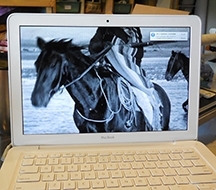
Reference photo on the computer

Reference photo on the computer

what I know should work as I’m stitching.  I also keep my laptop near by with a reference photo on display.  It is always such a treat to step back and look at the work and be able to appreciate that it has come together as planned.  Sometimes, it’s even better, like the stitching along the neck of this horse.  That’s when I smile, pat myself on the back, and say, “Lea, you’ve done well.  You should have some chocolate.”

After a cup of tea and a few Thin Mint cookies, I had to admit that I was not thrilled with the nose.  More on that next week…

Share

Does This Butt Look Big??

Too much off the edge

Too much off the edge

While fussing over the second horseman and I find a couple of problems with the composition.  I’m irritated by the horse’s back end hanging off the right side of the composition.  It seems to be too much.

Because I have already finished the background, extending it could be a problem.  Can it be done without creating a distinct line down the panel that is obvious and distracting??


horse butt after

Extending the water

I’ve got to try.  At this point, I think the key to the expansion project is to break up the vertical line.  As I add to each component of the background, I’ve got to stagger the additions of fabric.  The water is the largest area and most obvious, but I can camouflage that line with ripples.  Here is what I have at the end.  Let’s hope stitching hides the rest.

Try to ignore those black lines on the second photo.  I’ll explain them another day.

Share

Just the Right Face

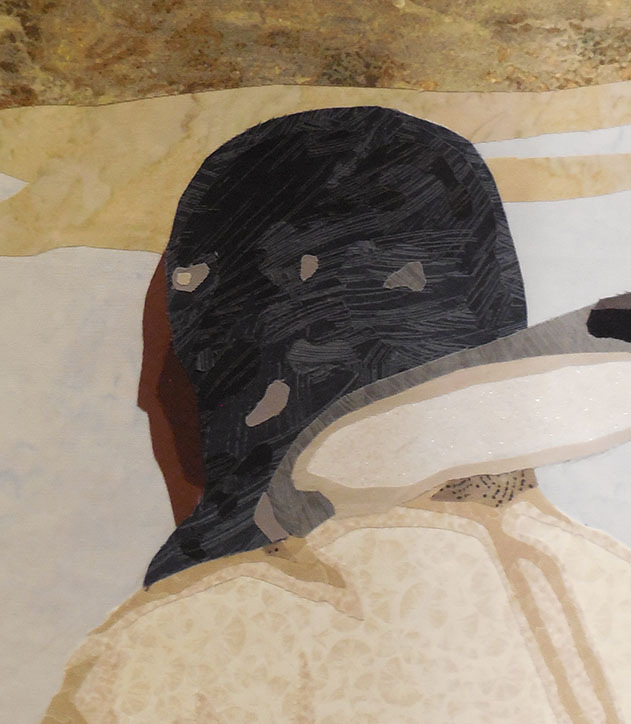
Too much shadow.

Too much shadow.

The second figure has come together, but I don’t like the face.  Even though it is turned away from the viewer, it is still important to get it right.


Hair and face distinguished.

Hair and face distinguished.

First, I don’t like that the head is a solid black shape as it creates too much shadow.  Replacing part of that black shape with brown helps to distinguish the hair from the face.


reference tools

reference tools

With that done, my attention now turns to the line of the profile. To make it accurate I  refer back to a drawing I did for my book showing the correct placement of features.  I hang it next to my fused image. BONUS: the drawing happens to be almost the same size as face of my rider.  Using a ruler I hang in front of the fused face, I place pins to mark important benchmarks: top and bottom of the head, bridge of the nose, bottom of the nose.


From there, I make some nips and tucks and put the best face forward.

Now its right!

Now its right!

Share

Blanket Statement

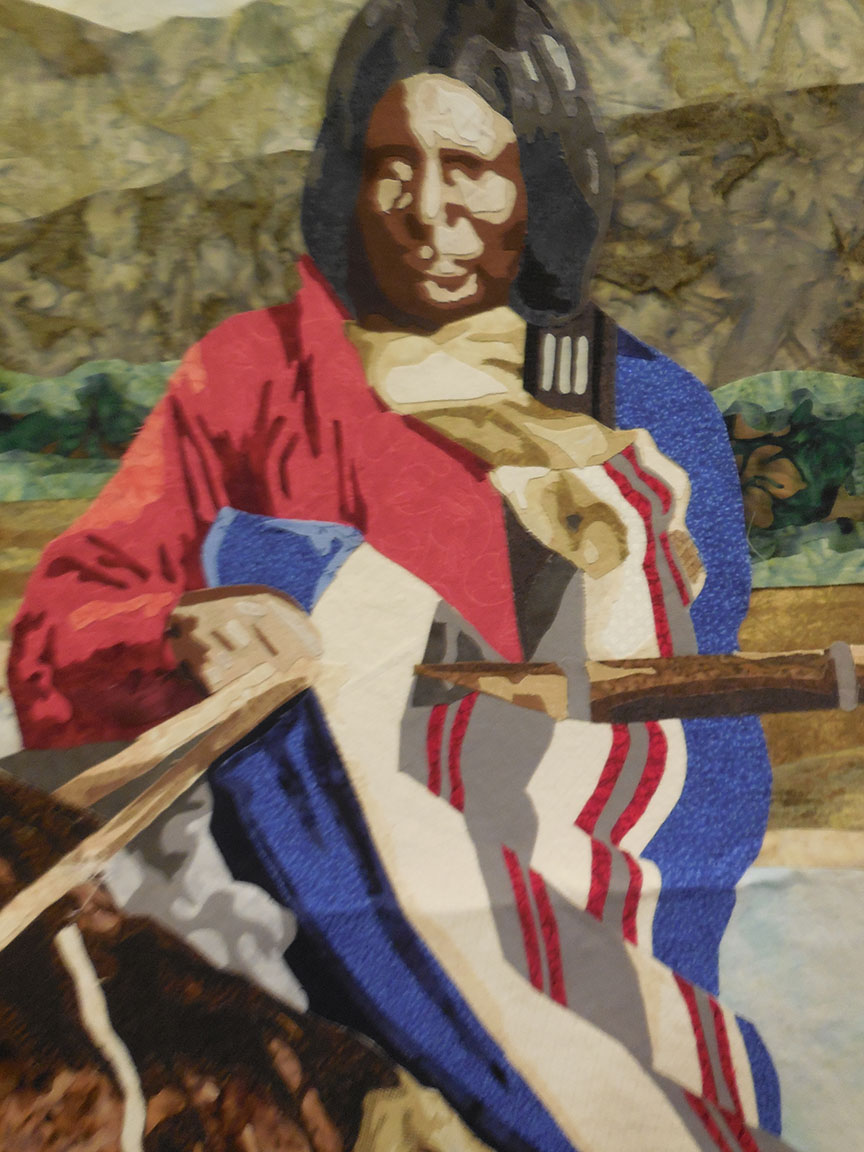
These last couple of weeks, I’ve frantically been working to complete the fusing portion of the center horseman panel before other, looming responsibilities interrupt me.  The body of the rider has taken a lot of energy.  There were many tiny pieces and a lot of confusion in sorting out what was what in the photo, but I finally put him together.

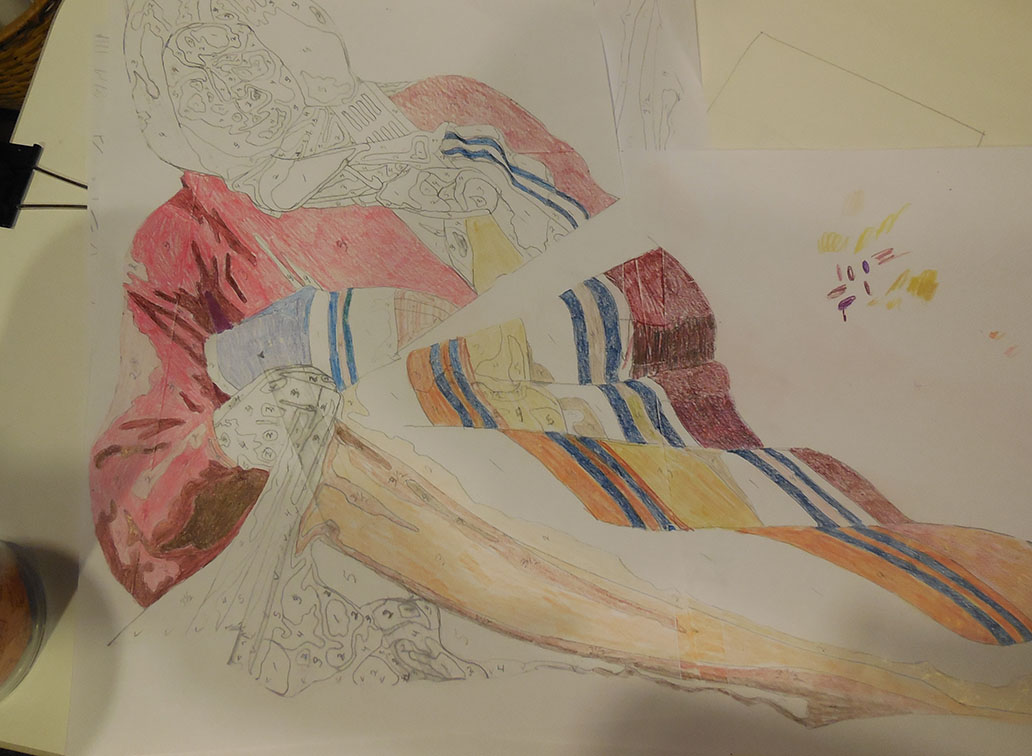
The big design decision here was the color scheme for the blanket.  The overall scheme for the piece is a double compliment: red-green, blue-orange.  Currently, a very dark orange is brought into the composition through the horse. I really wanted to work in some lighter warm orange in the blanket, but couldn’t visualize it.  Several photocopies of the pattern were made and filled in with colored pencils.  In the end, it was a red, white, blue, and gray scheme that worked with the rest of the composition. See the progress below.

A portion of the original photo

A portion of the original photo

Audition colors on paper. Orange isn't working

Audition colors on paper. Orange isn’t working

Blanket in progress in red, white, blue--and grey.

Blanket in progress in red, white, blue–and grey.

Finished rider.

Finished rider.

I’ll tell you about the background in a future blog.

Share

Sharing Student Successes

The reward of being a teacher is to experience the success of one’s students.  In recent weeks, I’ve been sent photos of finished work from several students.  Some of these photos have come from other states and other continents.  The magic of the internet is that it bridges great distances.  Below, please enjoy some of the work that others have done using my lessons on fused appliqué.

Work by Paula Tuaño, Bayberry Quilters of Cape Cod (disregard the dates in the corners of the photos.)

Asleep in the Car

Asleep in the Car

Three Bums from South Ferry flophouses,  Battery Park, NYC 1941

Three Bums from South Ferry flophouses,
Battery Park, NYC 1941

Work by Joan Musick, Colorado Springs

Oscar

Oscar

detail of Oscar

detail of Oscar

Work by Marie Glover, Yeelanna, South Australia

title unknown

title unknown


Portrait Quilt by Marie Glover,

Portrait Quilt by Marie Glover,

Thanks for sharing, ladies.

Share

I’m Making Water

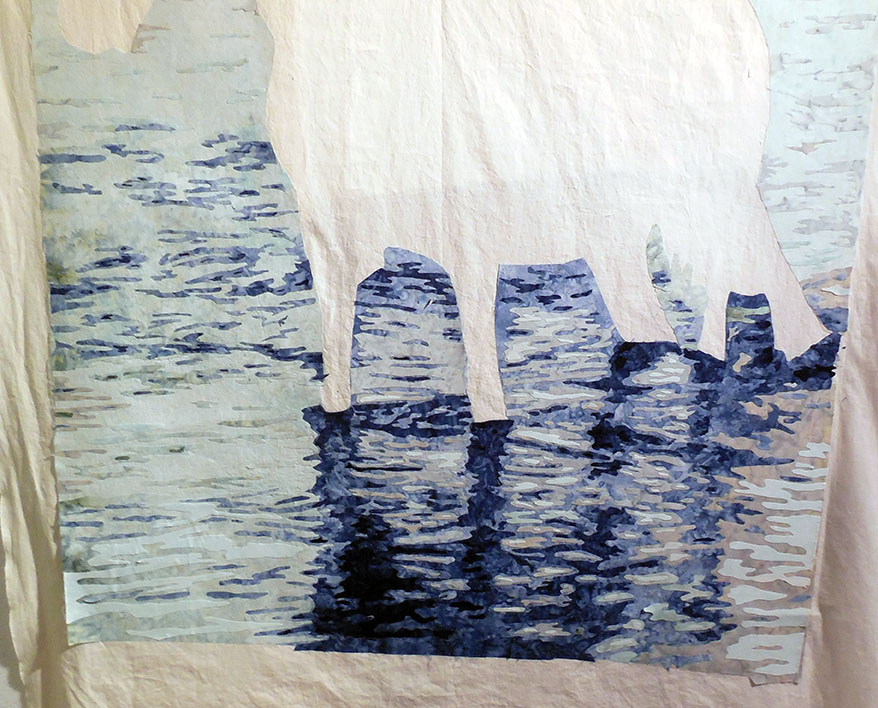
Finally, it’s time put start fusing fabric.  For my next piece, The Four Horsemen”, I’m starting at the bottom and working my way up.  That means creating the river that the horsemen are crossing.  Hand-dyed fabrics in cool blue and a slightly warmer blue-green are chosen.

water1Looking at the pattern, I see that there is a lot of value change and small pieces needed to get the effect of flowing, swirling water.  After studying the pattern, the best course of action seems to be to establish some larger value areas with big pieces of fabric and then apply smaller lighter and darker pieces over the top.Water 2


The process involves lots of tedious cutting, with sharp curves.  However, it worth it when I step back and can see the pattern of the ripples change as the water flows around the horses legs.  I’m pleased with the contrast of light-dark, and warm-cool.  It’s a good start.water-full


Share

What to do with Leftovers

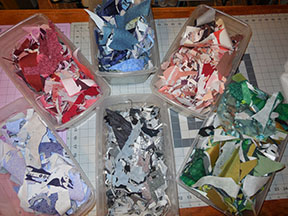
Boxes of leftovers

Boxes of leftovers

Part of preparing for a new piece, is cleaning out the studio to make space for the work. A significant by-product of my process is lots of scrap fabrics with fusible on the back.  These scraps come in unusual shapes and sizes.  I have trouble throwing them away, so I sort them by color and store them in small bins.  After completing Panning for Gold and Bike Boys, my neutral bins were over flowing.  It was time to act.

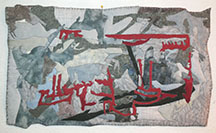
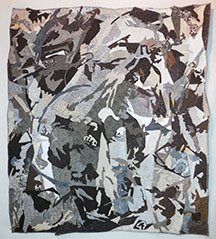
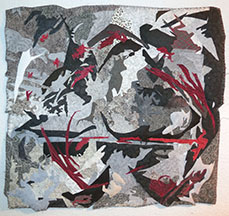
I sat down with my bins, some fat quarters and leftover pieces of muslin next to the ironing board and began to play.  The rules of this game were to use only the scraps in the bins, to act impulsively, and let ideas develop spontaneously.  There were no patterns, no preliminary drawing, and no end in mind.

It was quite cathartic, and once I got started, I couldn’t stop.  I created a new series that I now call “Remnants”.  Take a look.


Remnants I

Remnants I

Remnants II

Remnants III

Remnants III

Remnants IV

Remnants IV

Remnants VI

Remnants VI

Remnants V

Remnants V

Share

Embracing Limitations

I shake.  Most notably, my hands shake.   Some days are worse than others.  I have a condition called “Essential Tremor”. The diagnosis came back in the 90’s and after trying a couple of medications with side effects that were worse than the condition, I’ve resigned myself to live with it.

My photo of nephew Jake at his commissioning ceremony.

My photo of nephew Jake at his commissioning ceremony.

The condition has been both a curse and a blessing in my art. The tremor makes it difficult for me to take good photos.  I have a new camera that has an anti-shake feature, but some days, it’s just not enough.  I like to work from my own photos so that I don’t have to worry about copyright issues, but am finding that increasingly difficult.  This is a contributing factor to my working from historical photos.

stitching oops!

stitching oops!

Another reality is that I have difficulty sewing a straight line when stitching with my longarm machine.  If you ever see my work on a traditional quilt design, you would not be impressed.  The up side is that it led me to thread painting.  My style of free-motion stitching doesn’t rely on the same kind of precision.  When it is necessary to be precise with details, I must slow down.  Sometimes, I make one stitch at a time: needle up, needle down, needle up, needle down. Sometimes, I despair, wondering what will happen to my art if and when the conditions becomes worse.

I just found an inspiring TED talk by an artist with a similar condition.  It applies to anyone on a creative journey and I want to share it with you. Phil Hansen TED talk


Share

What’s new? It’s cold.

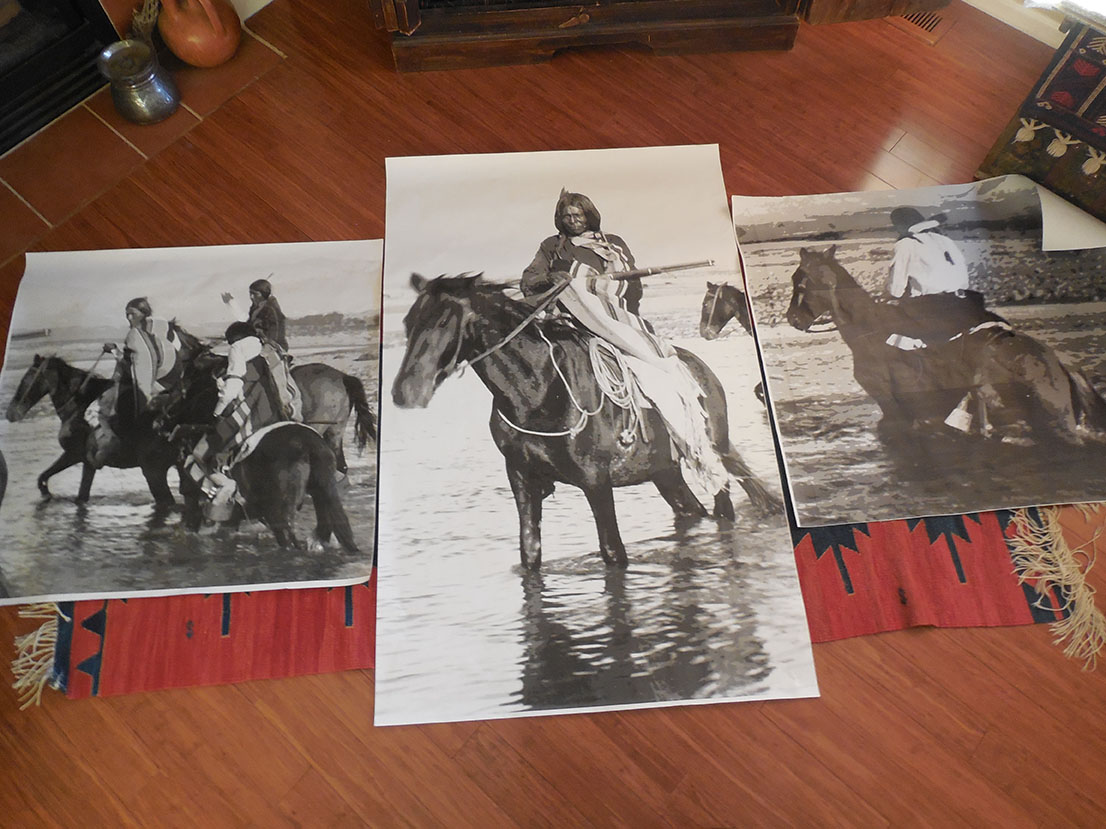
Finally! I’m starting on my next big piece.  Like Bike Boys, it is based on an historical photo from the archives of the History Museum in Denver.  The photo features a group of Native American men, I assume to be Lakota warriors, on horseback, crossing, what I suppose is the Platt River.

I’m changing the figures around to create a more pleasing composition.  In the original photo, the main figure sits tall on a horse looking directly at the viewer.  He is flanked on either on either side by figures in side or back view.  My plan is to flip these figures around so that the new figure on the far left is looking over his shoulder back toward the viewer and the central figure, thus bringing the focus back to the central warrior. I’m auditioning a couple of options for placement.

Option 1

Option 1


Option 1:  The size of the figures works for their placement, but the depth of water is wrong.


Option 2

Option 2

Options 2:  I like the diagonal flow of the composition, but the figure in the foreground is too small.  Enlarging him will throw off the balance of the piece.


The problem this creates has to do with the depth of the water. When looking at the horses legs and how deep they are in the water, everything gets confusing.  The solution is to change the position of the viewer. The original photo seems to have ben taken from the edge of the river, but I will shift the riders so that the viewer is placed in the center of the river, in the deep water, looking toward the far shore.

Temps outside the glass door are sub-zero.

Temps outside the glass door are sub-zero.

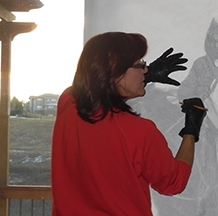
With that decided, I’ve begun drawing the pattern for the central t rider.  He’s so large that I must use my back door for a light table. Unfortunately, sub-zero temperatures are brushing up against the other side of that door. It takes only a few minutes of drawing for my fingers to begin to turn numb from the cold.  I find, that if I’m going to make any progress, I’ve got to don gloves to keep my hands warm.  It’s a little awkward, but do-able.


Share

Lights, Camera, Action

This is the week that the crew from TheQuiltShow.com comes to Denver to tape their next season of shows.  I was the guest artist on their first show in the new studio.  I’ve been to several tapings before, but there is nothing like being on the other side of the camera.  My husband , parents and sister were able to come and support me and help calm my nerves.  Here are a few shots from behind the scenes.

family on the set

Family on the set.

Alex holds my book

Alex holds my book.

computer prep

Ernie gets the computer to work

hanging quilts

Hanging quilts with Adele.

how does this work

Sewing lesson from Alex.

jim

Jim, my muse, my mentor

makeup

Makeup

my guys

My guys.

prep talk

Hmmmm.

sitting talking

Speaking of quilts.

Share