Let’s Make Faces

Look what I did!

I hope you are enjoying a beautiful summer: picnics, camping, swimming, baseball…

But, when you are ready to come in, cool off, and do something creative, I invite you to join me in a portrait quilt class or workshop.  There are spaces open in these locations:

CraftU Courses are once again open for registration: 

 August 13 – Brigham City Museum, Brigham City, Utah.

Jo's self portrait

Jo’s Self portrait

September 30-October 2, 2016 – Quilt & Fiber Arts Festival, LaConner Quilt & Textile Museum, LaConner, Washington

October 15-16, Jukebox Quilts Store, Fort Collins, Colorado

Portraits on Parade

Portraits on Parade


“Portrait Quilt Workshop” Sat-Sun, October 15-16, 2016. Call (970) 224-9975 for more information.

January 19-22, 2017, Road to California Quilter’s Conference, Ontario, California

Share

Puppy Love, Part 2

Oh joy!!! I’ve finished something in less than a month; 2 1/2 weeks actually.  It’s such a thrill to jump into a project and just breeze through to the end.  With this piece, I took a break from thread painting and just did some dense stitching.  The new challenge was to establish some designs that would fit with each element of the composition.

The blonde hair of the girl was easy.  I used various values of yellow threads in long, undulated lines of stitching.

PL hair

Next, similar, but shorter, wavy lines were put down with some variegated threads in a pattern that alluded to the hair of the dog.  Several times I had to stop and pet my dear Coco’s face in order to really understand the changing direction of her hair.  She didn’t mind too much.

PL dog

Stitching the face was a leap of faith.  It is so tricky to stitch the face!  If you try to recreate the actual contours, and the lines aren’t just right, it throws off the perceived shape and makes the face look distorted.  I decided to go in a completely new direction: loop-d-loops.  I covered the entire face in a small repetitive design that had nothing to do with its shape or contour.  I still varied the threads, letting the values do the work.  I’m really pleased with the results.

PL face

The background was the most troublesome decision, just as with choosing the fabric.  The print was complex and busy.  Afraid that it would become too strong and overpower other elements, I didn’t want to stitch the printed design.  I came up with a wandering ribbon design with a tiny meandering stitch to fill in the spaces.  I feel like the 2 patterns of the fabric and stitching sort of neutralize each other and take away their power to dominate.

PL background

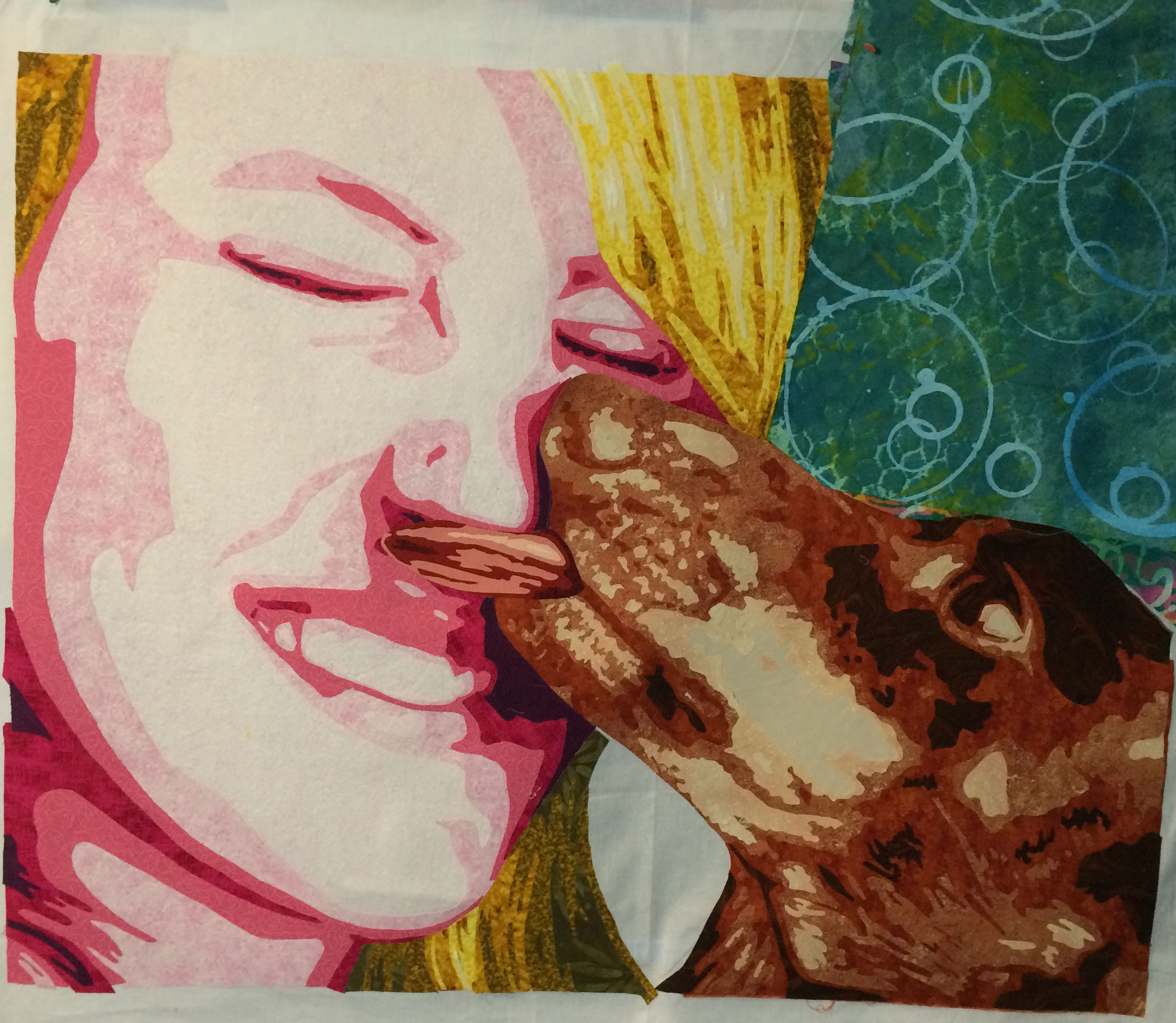
Finally, here’s the finished piece.Puppy Love

Share

Puppy Love, Part 1

Maya & Coco

Maya’s selfie

This week I’ve jumped back into my art with gusto.  I’m tired of being on hold. I need to be creative!!  With a 4-day weekend and plans to pack and move postponed (again!) it was time to make up for lost time.

4" x 6" thread painting.

4″ x 6″ thread painting.


This past week has been devoted to making a piece titled “Puppy Love”.  I’ve done smaller versions of this piece in the past for small art auction donation pieces, but this one is big and bold.

It started with a selfie taken by my step-daughter, Maya with our little dachshund, Coco.  While previous versions were printed on fabric and thread-painted, this one is raw-edge fused appliqué and 30″ x 40″.

My color scheme is an analogous run of yellow-orange, orange, red, red-violet.  This kind of scheme tends to be calm and mellow, so, to punch it up, I threw in some blue-green.color scheme

A couple of marathon work days, and the piece was nearly completed.  Selecting the background fabric had me stalled for day as I just couldn’t decide.  I took audition photos with my phone and toggled back and forth between the shots until I was able to make a decision.

Background option 1

Background option 1

Background option 2

Background option 2


Now, it’s on to the stitching.  I’m going to try something new and will share that with you next week. Check back in next week.

Share

Starring Roles and Supporting Roles

I’ve just posted a new video showing how to use a value scale to select fabrics for various elements of a pictorial composition.  By managing the value range you can make some people or items stand out more than others.   Here is a photo of a self portrait I did with high value contrast

This piece has high value contrast.

This piece has high value contrast.

I’ve done a second version of this with a narrow value range.  I did this by replacing the very lightest and darkest fabrics.  It would seem that I’ve already packed that piece in anticipation of moving to a new house and didn’t take a photo first.  You can see it, however, in my latest video.

Value Finding Tools Part3: Starring and Supporting Roles

Share

Fused Applique Portrait Class

My Fused Applique Portrait class at CraftU begins March 7. There is still time to sign up. Here’s a link if you are interested:

Fused Raw-Edge Applique Portraits

https://www.craftonlineuniversity.com/courses/fused-raw-edge-applique-portraits

 Here are some samples of portraits done with this technique:

portrait-Jim Lea applique portrait

Share

Is Your Face in the Right Place?

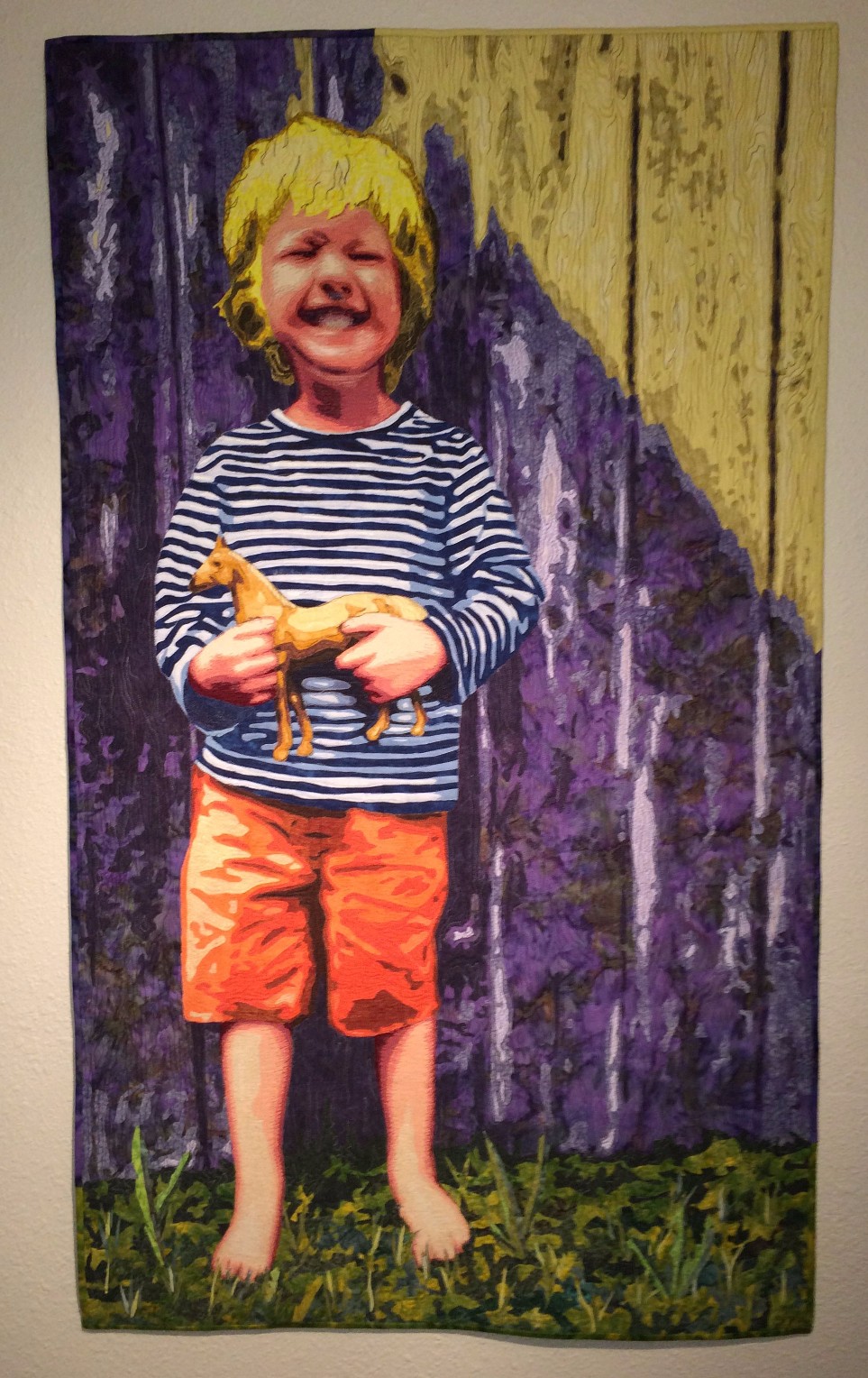
I’ve just finished a new piece titled “Simple Pleasures”.  It features a young boy named Indigo who is celebrating his 6th birthday and is thrilled with his new plastic horse.  How wonderful to find such pleasure in something that has no bells, whistles, screens, login, or even batteries.

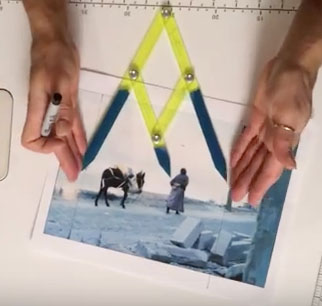
In this weeks video, I show you how to check the size, location, and dimensions of facial features so that the face looks realistic and well proportioned.

Golden Mean Calipers Pt 3: Facial Features

This piece was a chance for me to try a bolder color scheme.  I like the energy and vibrancy of it. Below are process photos to show how the piece came together.

Face and Hands

Face and Hands

Shirt and shorts

Shirt and shorts

Horse in Hands

Horse in Hands

Thread-painted face

Thread-painted face

Finished piece

Finished piece


Share

Fibonacci Sequence Strip Quilt

This week I want to share with you a quilt made by my friend, Jeanne Lounsbury.  She made a strip quilt for her son using the Fibonacci Sequence (1, 1, 2, 3, 5, 8,…).  When she shared it with our local quilt group, I got really excited and thought others would appreciate it, too.  She used my favorite hues of blue with a pop of red.  Here is the link to the Fibonacci Sequence Strip Quilt video.

I’m currently in the middle of my 2-week winter vacation from school and am thoroughly enjoying the extra time to work in my studio.  Next week, I should be ready to share with you my latest piece.  Stay tuned.

Share

Golden Mean Calipers Part 2: Crop a Picture

This is my second video on how to use the Golden Mean Calipers.  This week I show you how use them to crop a photo around a focal point so that the outer dimensions are harmonious and the subjects in the composition are well placed. These calipers are available in my web store.  If you find these videos interesting or helpful, subscribe so that you get notified whenever I post a new one.  I’m trying to do this once a week until I run out of things to say—like that could ever happen.

Calipers video part 2

calipers 2

Share

Golden Mean Calipers Part 1: Establishing Borders

This is my first video about how to use Golden Mean Calipers.  Ever Wonder how wide to make your borders.  You can use this tool to find a width that is in harmony with the size of your blocks.  If you already know the finished width of the borders you need, use the calipers to determine the best way to divide that width into multiple borders and sashing.

I’m not done with the Value Finding Tool Kit.  Watch for more videos using a variety of design tools.  Subscribe to my YouTube Channel: Lea McComas Fiber Art to see them.

Here is the link to this week’s video:

Golden Mean Calipers Part 1: Establishing Borders

Use the calipers to determine the width of your borders

Use the calipers to determine the width of your borders

Share

Value Finding Part 2: Near & Far

I’ve just posted Value Video Part 2.  Watch this video to learn more about how to use my Value Finding Tool Kit when making pictorial quilts.  This week learn about using the concept of value when building a landscape composition.

Next week I’ll post my first video showing how to use the Golden Mean Calipers.  I hope you are enjoying watching the videos in place of a text blog.  It is certainly more fun for me to share my thoughts via video rather than text, at least for now.

I’m hoping to build a following on my YouTube channel, so if you like the videos, please subscribe to the channel and share it with others who might be interested.

Share