Using the Golden Mean Calipers


Golden Mean Calipers

Today, I want to share with you a tool that I’ve discovered called the Golden Mean Calipers..  I’ve also seen them labeled “Fibonacci Gauge.” can be a useful design tool in your artistic process. There are a variety of ways this particular tool can be used. Let me illustrate a few.

Finding the Sweet Spot Within Your Composition

A focal point is used to grab the viewer’s eye and engage the viewer in your artwork. Generally, it is best to avoid taking the viewer’s eye to the center, for when it arrives there, it will tend to stop and rest. Placing key elements off center will tend to prolong the viewer’s engagement with the composition. Use the calipers as shown below to determine the best placement of the focal point and other key elements of a composition. In portraits, eyes and mouths are important features for focal points.

Use calipers for cropping the sides of an image.

Use calipers for cropping the sides of an image.

focal point 1

Lay the calipers over a photo print, to determine the best way to crop it.

Focal Point Landscape

Use the calipers to determine the placement of a design element within a larger panel.

Taking Elements Off the Edge

Avoiding the middle also applies when taking lines or elements off the edge of a composition. See how the calipers can be used to determine the most visually pleasing locations for the placement of lines that will carry the viewer’s eye to the edge of a composition.edge 2edge 1

edge 3

Creating Borders with Harmony

This tool is also useful when adding borders to a traditional block quilt. One method is to start with the blocks themselves. Place the outer points of the calipers at the edges of the blocks. This will give you two new measurements that will be in harmony with the blocks. Use the larger measurement for the total width of the border. This area can further be divided by placing the outer points of the calipers on the edges of the border area. This will indicate pleasing widths for and inner and outer border. All measurements indicate finished sizes. Don’t forget to add seam allowances.

Measure the width of your block.

Measure the width of your block.

Create a single border matching the wider measurement of the calipers.

Create a single border matching the wider measurement of the calipers.

Create harmonious smaller borders.

Create harmonious smaller borders.

Divide the border area using the calipers.

Divide the border area using the calipers.

Sometimes, a specific finished size is necessary and this isn’t achieved in the process above. In this case, determine the desired total width of your outer borders, open the calipers to this desired width and then measure the distance between the points to determine the finished widths of an inner border and outer border.

Perfect Facial Proportions.

The Golden Ratio occurs naturally within faces and calipers are useful when creating portrait works, either when drawing the face, or problem solving when a face doesn’t look quite right. See the photos below for ways to check the proportions of the face, and placement of the features.

Placement of mouth between nose and chin

Placement of mouth between nose and chin

face 1

Bring of the nose in relation to forehead and chin.

Placement of eyes

Placement of eyes

If you are interested in learning more about facial proportions and portrait quilting, check out my book, Thread-Painted Portraits: Turn Your Photos into Fiber Art 

AND look for videos on my YouTube Channel Lea McComas Fiber Art.

Share

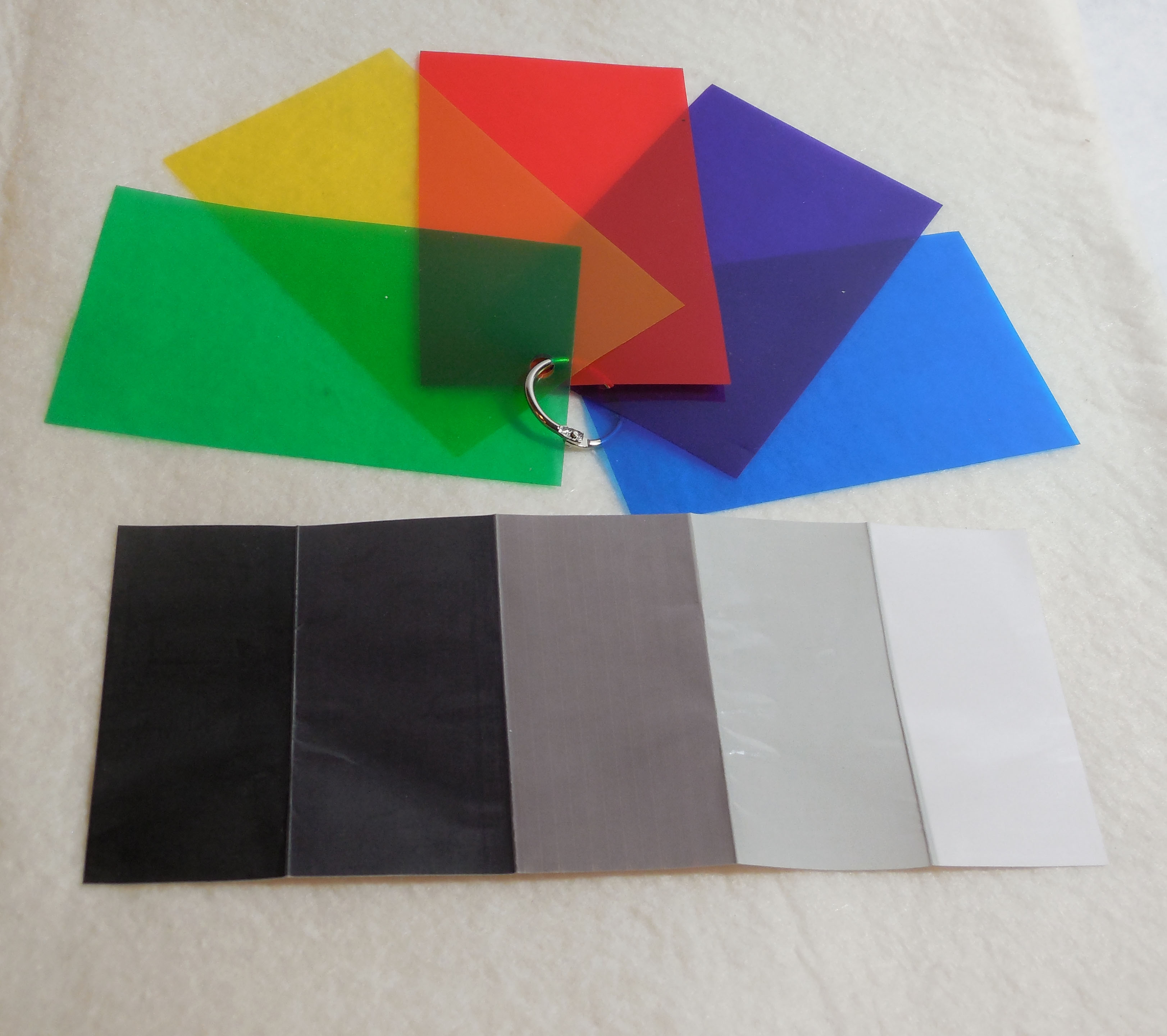
Value Finding Tools

I’m trying something new in my blog this week: a video.  This is my first attempt, and let’s just say, it was a learning process.  I’m thankful that I get to spend a large part of my day with teenagers who know all about this and are happy to advise their teacher.

Follow this link to learn about the tools I use to select fabrics.    Value Finding Tools Video

These tools are available in my web store if you want a set of your own.

Value Finding Tool Kit

Value Finding Tool Kit

Share

The Tale of a Tail

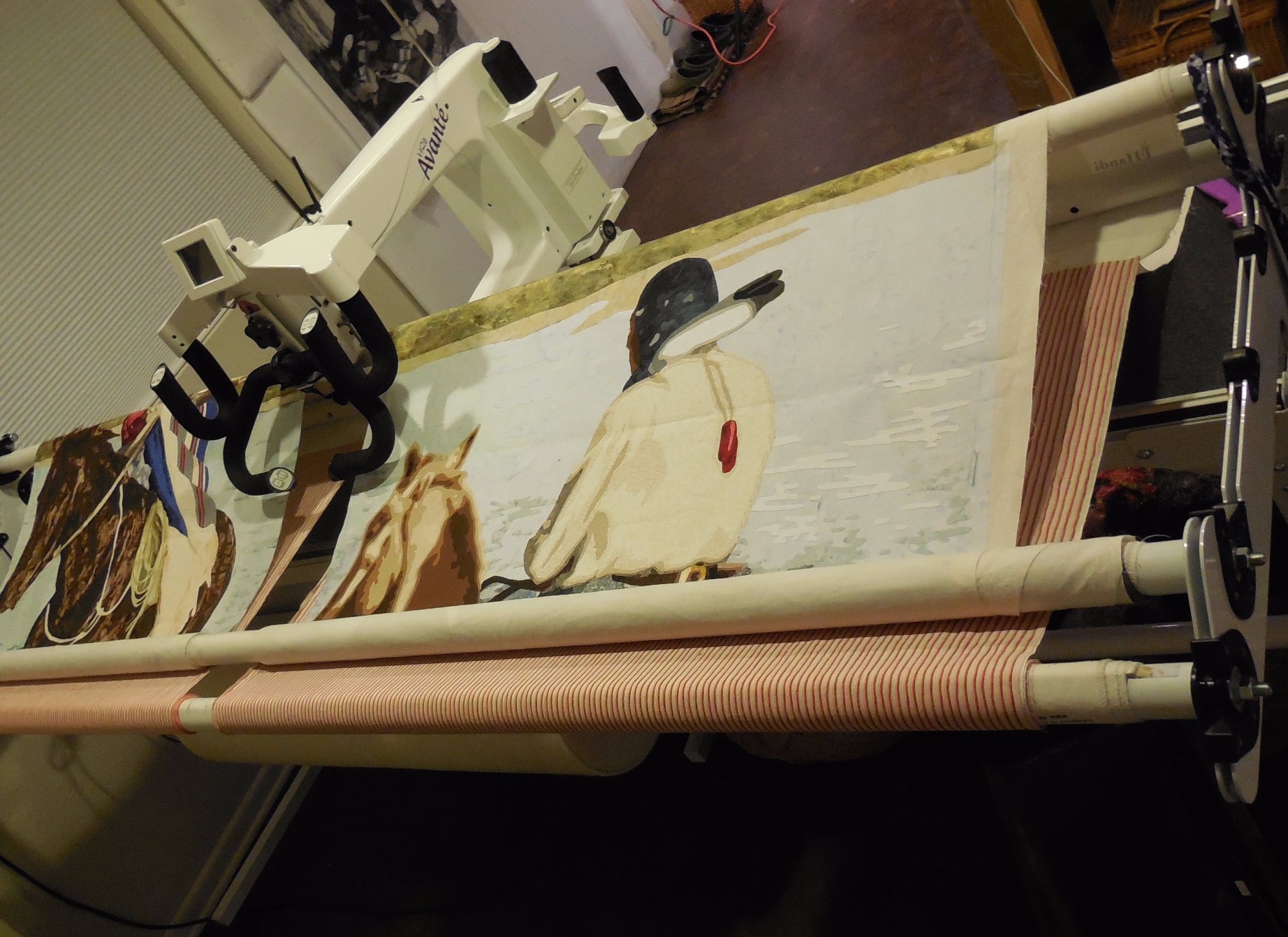
Too Much Tail

The tail is too big for the longer frame.

A you may recall, when I first loaded both of the horsemen panels on the longarm frame, the tail of the right panel hung off the edge.  At the time, I chose to ignore this and deal with it another day.  That day came.

The beginning of the solution involved removing both panels and reloading them one at a time.  This move actually solved two problems.  Thread painting the first horse caused that panel to draw up, in turn, making the second panel too loose on the frame.  The initial reason for loading both panels at the same time was so that the backgrounds could be stitched together, creating some continuity across both panels.  With that done, it is now obvious that that the panels will be completed one at a time.

With the second panel off the frame, I add extensions to the backing and batting.  When it is reloaded, I use clamps to hold that extension tight and in place while the stitching is completed. (sorry, forgot total a photo)

Boning to stiffen the tail

Boning to stiffen the tail

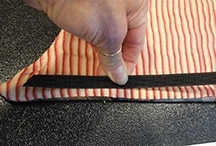
The next problem to be addressed is how to keep the tail from curling back or flopping forward when it is on display.  That solution comes from the notions department of my local fabric store:  polyester boning, typically used to give shape to a dress bodice.

This piece was finished with an artists facing, rather than a binding.  A strip of the boning was stitched into the bottom edge of the tail extension, then covered with the facing.  This seems sufficient to keep it in place.

Horse tail finished.

Horse tail finished.

Cover up with facing

Cover up with facing

Share

“No” to the Nose

original nose

Original photo

When I thread paint, I rely on the thread to do the bulk of the work.  My technique allows me to blend colors and create subtle shading and contours, as if I were working with paint. In my process I find that there is an OTZ (Optimum Thread Zone).  Stitching below the zone creates what I consider dense quilting, and stitching above the zone overloads the fabric and causes it to expand and buckle.

With this in mind, I consider the facelift that is needed by my horse. As mentioned last week, the shape of the nose needs some adjusting.  However, having applied heavy stitching to the face already, there is a limited amount of thread that can be added without exceeding the OTZ. This means I need to get it right, right away.

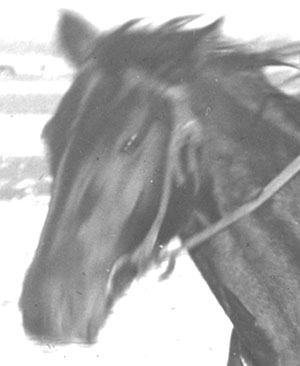
In the original photo, the horse is moving his head as the photo is snapped, so it is blurred and doesn’t provide the details that I need.  It is off to the internet to find images of horse heads that face the right direction, at a similar angle, and in the right light.  I also look to reference books of paintings done by several Western artists.

sketch of nose on plastic sheet

sketch of nose on plastic sheet


Next, I place a clear plastic sheet over the face of my horse and outline its shape and key lines with a red marker.  That sheet is then set on a white background where  black lines  indicate where stitching is to be added or changed.  In this way, I can audition the additional stitching, erase, and redo as needed until it’s right.


Back at the longarm frame, I keep this plastic sheet handy and begin the facelift.  In addition to creating a more boxy snout, highlights were added around the nostril and above the eye to give them more depth.

Facelift results

Facelift results

First Face

First Face


Share

A Horse of Course

I’ve been away from the blog for a while, but, as you might have guessed, progress did continue on the horseman.  In my race to finish it in time to submit to the Houston quilt competition, all available resources were diverted to making progress on this piece.  I did take some photos along the way and will share that progress with you in my next few blog posts.

Shiny and dull threads for this horse

Shiny and dull threads for this horse

This week, let’s focus on the stitching of the first horse.

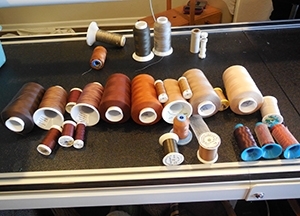
I selected a variety of threads in the full value range.  This first horse is pretty dark, and if I think about what the horse would look like in real life, my thread choices would fall in the medium to dark range.  My analytical brain has to take over to pick the very lightest threads.  Because this horse is standing in water,  a selection of threads with dull and shiny finishes were chosen to differentiate between the wet and dry parts of the horse.

Often, stitching begins with the lightest threads, working toward the dark areas, but this time, I did the opposite. I can’t say why with certainty.  Perhaps it’s because the dark threads will complete most of the stitching and the lighter threads will add the finishing touches.  The first step is to make some broad, sweeping stitch lines to hold things in place.  That is followed by several passes, filling in more and more each time.

These photos show how the work progressed.

Stitching horse 0

Stitching horse 1

Stitching horse 2

stitching horse 3

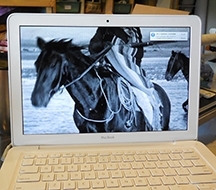
While working up close, it’s hard to fully appreciate what is happening.  I have to rely on

Reference photo on the computer

Reference photo on the computer

what I know should work as I’m stitching.  I also keep my laptop near by with a reference photo on display.  It is always such a treat to step back and look at the work and be able to appreciate that it has come together as planned.  Sometimes, it’s even better, like the stitching along the neck of this horse.  That’s when I smile, pat myself on the back, and say, “Lea, you’ve done well.  You should have some chocolate.”

After a cup of tea and a few Thin Mint cookies, I had to admit that I was not thrilled with the nose.  More on that next week…

Share

See Me on The Quilt Show

I recently taped an episode of TheQuiltShow.com with Alex Anderson and Ricky Tims.  Subscribers to that website got to see that episode last week.  Many thanks to those of you that sent kind words through email and Facebook.

sitting talking

Photo by Gregory Case

Now, I can share a link to that show with the rest of you. Click on the link here and you can watch too.

Watch The Show

This link will work until May 11, so make a cup of tea and sit back to enjoy.

Let me know what you think Also, for those of you that subscribe to The Quilt Show, I have a new series of lessons in the “Classroom” section of the website.  This course is on “Contemporary Batik”  If you’ve ever wanted to try batik, but were afraid of the mess, check out this class.  It will be FUN, and EASY!! http://thequiltshow.com/learn/classrooms FTI: you have to be a subscriber to the website to access this class.

Share

Let the Stitching Begin

My apologies for being away from the blog for several weeks.  I’ve been desperate to get back on schedule with the horsemen so that I can finish them within the month, and any time spent writing is time I’m not stitching.  So, stitching I’ve been doing.  I did have the presence of mind to snap a few photos as I went along and I’ll share some of those below.

Before I get to the Horsemen, I want to share 2 bits of info:

1. I recently taped an episode of TheQuiltShow.com.  It is being aired today for those that subscribe, but next week I’ll send out a link for friends and family to view the episode for free.  I’ll post a link here on the blog, and on my Facebook page.

2.  My friends at QuiltForChange.org haver come up with a new challenge: Water is Life: Clean Water and its Impact on the Lives of Women and Girls around the World.  The exhibit will open at the UN headquarter in Geneva in January 2016. Entries due by November 1, 2015 If you want to quilt for a cause, you should check this out.  Here’s a link to their website: Quilt for Change Challenge

Now, to the horsemen…2 on the frame

With 2 panels to be stitched, I want to be sure that there is some continuity between them, especially in the background.  It should appear to flow from one panel to the next. I’m afraid that if I work one, then the other, I may not match up the right  threads or the lines of the composition won’t flow, so I’ve decided to put load both panels on the longarm frame together.  This turns out to be a little trickier than I thought it would be.  There is a lot of extra attention to be given to how tightly things are wound (the quilt layers, not me personally)  All was going well until I got Too Much Tailto the bottom of the second panel.  It would seem that I too much tail.  One of my horses hangs off the end of the frame.

I’m moving forward and I’ll figure how to deal with this later.


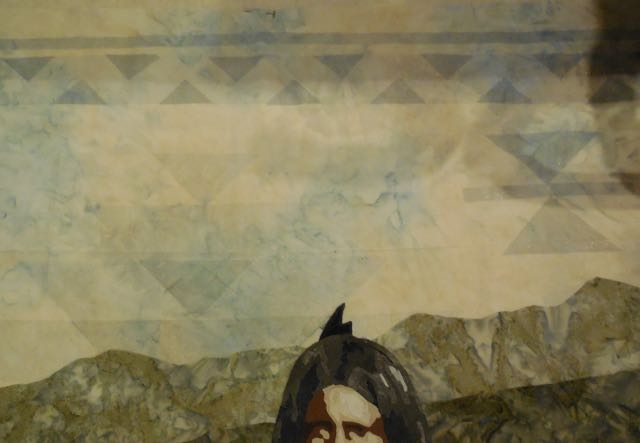
Just as I’m about to get started, I decide that the sky is to plain, it needs a little pizzazz, but what??In the Sky

I decide to create an overlay of a blanket motif over the top.  It can’t be too strong.  I want it to be a secondary design that support, not overwhelms the overall composition.  To do this, I draw out a design on paper and the cut the pieces out of tulle; light, medium and dark blue tulle.  I put fusible on one side and lightly iron the pieces in place before placing a very thin layer of champagne colored tulle over the entire piece.


Share

The Tangled Web

I’ve managed to get the first two panels of my 4 Horsemen triptych fused together and have come to terms with the reality that I will not get the 3rd panel finished in time for my May deadline. I will make the 3rd panel—someday—maybe in the summer.

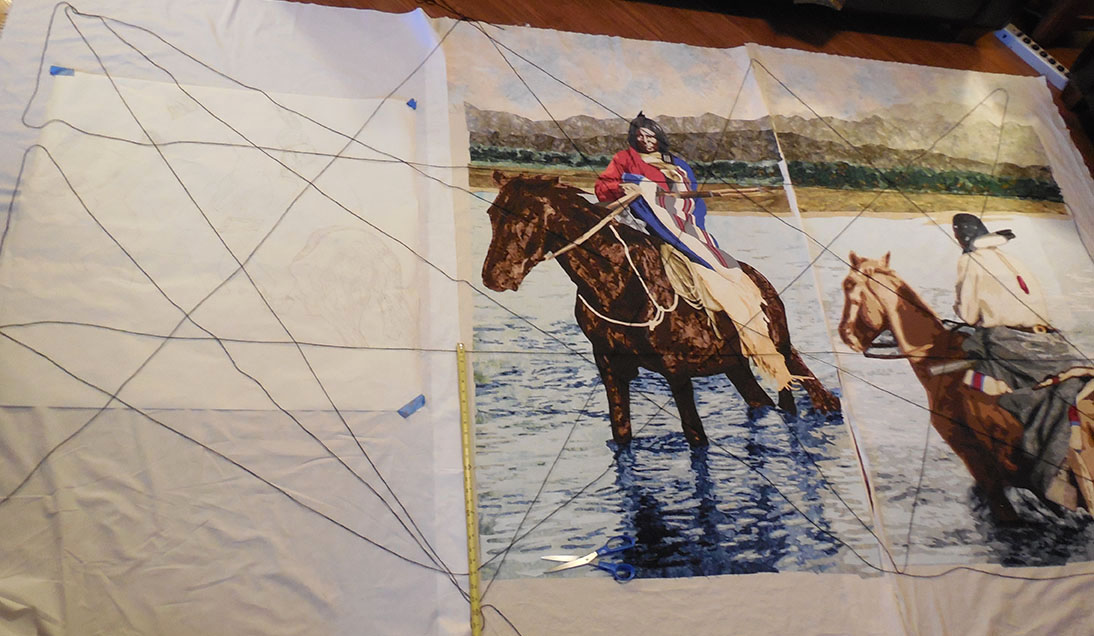
Before I can begin stitching, I must to do some planning and prep work now if the three panels are to fit together later. Toward that end, iI want to make sure that each panel works individually AND in concert with each other.

Panels side by side

Panels side by side

Here is the process:

  1. Lay the panels side by side. (Panel 3 is just a large sheet of muslin)
  1. Mark the corner points and 1/3 marks along each side.
  1. Run a line of string string between each of these key points.

In doing this, I can accurately place lines of the riverbank, foothills, mountains, and place the final riders in just the right position. Additionally, this web of string creates a grid for identifying key lines and points of intersection within the piece.

Here is my dilemma: the whole thing is way to large to fit on my design wall. The best I can do is clear the floor in my family room and lay out the panels. Unable to pin into the hardwood floors, I’m left to lay the string on the floor and they won’t stay put.  They are continually shifting as I move things around under them.  Eventually, I do get a sense of how things are laying out.

I see some good things going on in the right panel:

Lines o the right panel

Lines o the right panel

  • A diagonal goes down the face, hits the shoulder, belt buckle, then follows the line of the tail
  • Another diagonal follows the line of the neck, a crease in the blanket, and the shadow of the back haunch.
  • The lower horizontal connects the reins, rifle, and blanket fold


In the center panel:

Lines on the center panel

Lines on the center panel

  • A diagonal connects the hand, a stripe of the blanket, a line of rope, and then runs down the back leg
  • Another connects the eyes, bottom of the rope and follows the tail.
  • The lower horizontal runs along the belly of the horse


In the left panel:

Lines on the left panel

Lines on the left panel

  • I place the horses in the center between the horizontal strings
  • Diagonals from the upper left corner will fall along the head and back of the horse and also connect the nose, chest and stirrup.
  • I also sketch in lines for the background so that it will all come together in the end.


Doing this on the floor stinks! Every time I move something, I have to reposition the strings.   To make things worse, my trusty companion, Coco, has her own ideas about the placement of these strings.   I love her, but I REALLY don’t appreciate her design sensibilities.

Coco tries to help

Coco tries to help

Share

Does This Butt Look Big??

Too much off the edge

Too much off the edge

While fussing over the second horseman and I find a couple of problems with the composition.  I’m irritated by the horse’s back end hanging off the right side of the composition.  It seems to be too much.

Because I have already finished the background, extending it could be a problem.  Can it be done without creating a distinct line down the panel that is obvious and distracting??


horse butt after

Extending the water

I’ve got to try.  At this point, I think the key to the expansion project is to break up the vertical line.  As I add to each component of the background, I’ve got to stagger the additions of fabric.  The water is the largest area and most obvious, but I can camouflage that line with ripples.  Here is what I have at the end.  Let’s hope stitching hides the rest.

Try to ignore those black lines on the second photo.  I’ll explain them another day.

Share

Just the Right Face

Too much shadow.

Too much shadow.

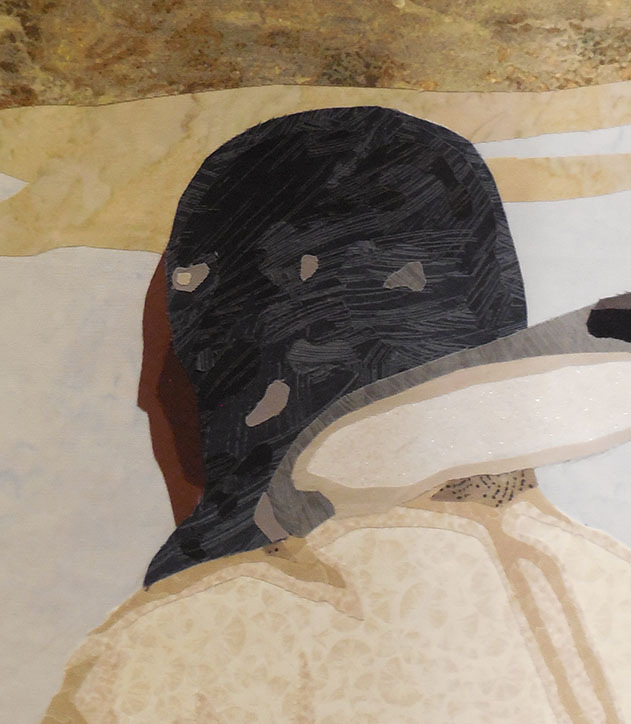
The second figure has come together, but I don’t like the face.  Even though it is turned away from the viewer, it is still important to get it right.


Hair and face distinguished.

Hair and face distinguished.

First, I don’t like that the head is a solid black shape as it creates too much shadow.  Replacing part of that black shape with brown helps to distinguish the hair from the face.


reference tools

reference tools

With that done, my attention now turns to the line of the profile. To make it accurate I  refer back to a drawing I did for my book showing the correct placement of features.  I hang it next to my fused image. BONUS: the drawing happens to be almost the same size as face of my rider.  Using a ruler I hang in front of the fused face, I place pins to mark important benchmarks: top and bottom of the head, bridge of the nose, bottom of the nose.


From there, I make some nips and tucks and put the best face forward.

Now its right!

Now its right!

Share